
Meta Attribution Change Broke Your Baseline
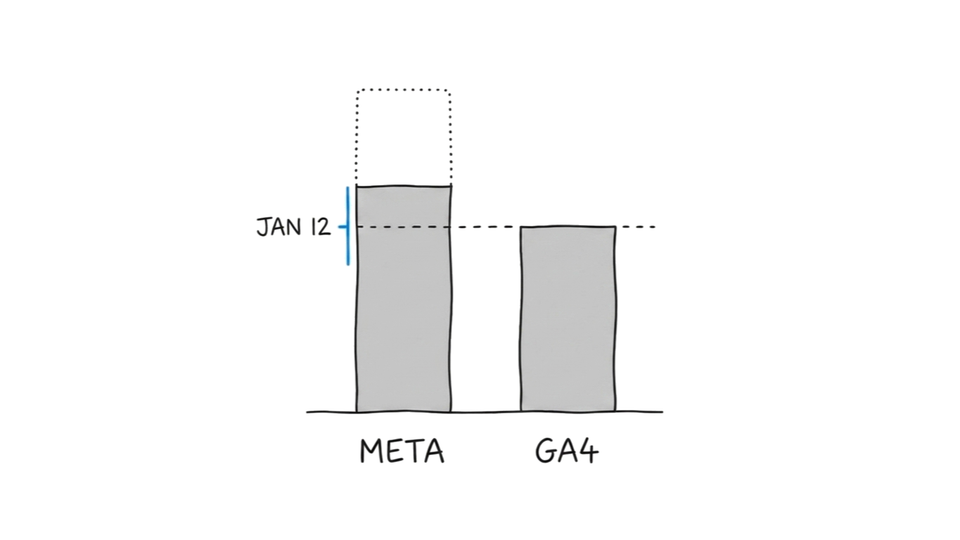
- Meta attribution window change on January 12, 2026 removed 7-day and 28-day view-through parameters from the Ads Insights API
- GA4 never counted view-through conversions, so the January drop was a measurement change, not a performance decline
- Any cross-platform baseline comparison that crosses January 12 needs recalibration to 1-day view window data only
The campaign audit came back clean. Creative was fine. Audiences were fine. Budget pacing was fine.
The numbers were still wrong.
Meta attribution windows are the conversion counting mechanism inside Ads Manager, and their January 2026 removal made every cross-platform performance comparison built on view-through data directionally wrong. The campaigns did not decline in January. The measurement system changed, and most practitioners found out three weeks later, after they'd already told someone the news.
Meta Attribution Windows Disappeared January 12
On January 12, 2026, Meta removed 7d_view and 28d_view from the action_attribution_windows parameter in its Ads Insights API. The only view-through window that remains is 1d_view.
The Meta Developer Blog announced the change on October 16, 2025. Chris Cutlip posted the deprecation notice at developers.facebook.com/docs/marketing-api/out-of-cycle-changes/occ-2025/ while most practitioners were running Q4 campaigns. The effective date was January 12.
Meta attribution window parameters determine which conversions Ads Manager credits to an ad impression or click. The 7d_view parameter credited a conversion when a user saw an ad and converted within 7 days, with no click required. The 28d_view parameter extended that window to 28 days.
Both are gone.
Dataslayer's January 2026 analysis found that advertisers relying on 7-day and 28-day view windows saw attributed conversion counts fall 30-40%. That range maps to view-through reliance. Advertisers running video and awareness campaigns, where view-through accounts for a significant portion of credited conversions, produced the larger drops.
GA4 Didn't Register the Same Drop
Your GA4 conversion data held steady in January. That should have been the first signal.
If campaigns had degraded, GA4 and Meta would both show declines. One platform dropping while the other holds flat points to a measurement change, not a performance change. Meta attribution window removal caused a drop in Meta's reported conversions. GA4 was not measuring the same thing to begin with.
GA4 attribution defaults to session-scoped last click. GA4 does not credit conversions to ad impressions. A user who sees a Meta ad, does not click, and converts three days later registers in GA4 as organic or direct, depending on what session brought them to the site. Meta's 7d_view parameter credited that same conversion to the ad.
Meta was counting conversions that GA4 never counted.
When Meta removed the 7d_view and 28d_view parameters, its conversion count dropped toward what GA4 had been reporting all along. The campaigns looked like they degraded. They didn't. Two different counting systems moved closer to the same number.
The practitioner who escalated a January decline to a client call was solving the right symptom with the wrong diagnosis.
The GA4/Meta Gap Just Got Wider
If Meta's numbers dropped to match GA4, shouldn't the gap be smaller now?
The GA4/Meta attribution gap is the difference between what Meta attribution windows credit to ads and what GA4 attributes to the same sessions. Before January 2026, that gap had a predictable shape. Advertisers running high-impression campaigns, video and reach objectives, showed larger gaps because view-through conversions added volume to Meta's count. Click-focused direct-response advertisers showed smaller gaps.
The gap didn't close after January 12. It changed shape.
Advertisers who ran awareness campaigns lost the most attributed volume. Their historical Meta numbers reflected substantial view-through activity. Their post-January Meta numbers don't. GA4 never tracked that activity.
The before/after comparison is now fundamentally different for awareness-heavy accounts than for direct-response accounts, even if underlying business performance was identical across both.
| Account Type | Pre-Jan 12 Meta Count | Post-Jan 12 Meta Count | Baseline Comparability |
|---|---|---|---|
| Awareness / Video | High — includes 7d + 28d view | Lower — 1d view only | Incomparable without re-pull |
| Direct Response | Click-dominant; smaller gap | Minimal change | Relatively stable |
The GA4/Meta attribution gap didn't close after January 12. It became asymmetric by campaign type.
A blanket before/after comparison that crosses January 12 shows a larger apparent decline for awareness accounts and a smaller one for direct-response accounts, even when actual performance was identical across both periods. Treating that comparison as a signal produces the wrong answer.
Recalibrate Your Meta Comparison Baseline
The fix is methodological, not technical.
Meta comparison baseline is the historical dataset used to evaluate current campaign performance. Before January 2026, that baseline included 7d_view and 28d_view conversions. After January 12, it doesn't. Any YoY, MoM, or QoQ comparison that crosses January 12 is comparing two different counting systems.
Set January 12 as a baseline break point.
Re-pull pre-change data from the Ads Insights API using only action_attribution_windows=["1d_view"]. This removes view-through volume from the historical period and makes the before/after comparison like-for-like. The pre-period absolute numbers will be lower than what was originally reported. The trend line will be accurate.
Add a notation to any report spanning January 12: "Meta attribution window change effective January 12, 2026. Pre/post figures normalized to 1-day view window."
One thing worth stating directly: recalibrating the comparison baseline addresses reporting comparability only. The 7d_view and 28d_view windows are gone permanently. If view-through conversion volume was a real performance driver for an account, that signal is gone. Not obscured. Gone. The recalibration shows that performance didn't fall. It does not restore the attribution signal that was removed.
For the structural picture of why GA4 and ad platform numbers diverge across measurement systems, the ads-to-GA4 gap analysis covers the underlying mechanism.
The January numbers pointed somewhere. Every cross-platform report before January pointed somewhere too. The measurement system was always going to create this moment. Meta was counting conversions nobody else counted. The API change made the counting visible.
Reset the baseline. Every comparison built from a calibrated starting point is trustworthy. That is not a small thing. Most practitioners never get there.