
The Button Problem
If generating something takes no effort, what signals that it has value?
The Musician's Nightmare
In 2023, a producer shared a confession that haunted creative communities:
"I spent three hours making a beat. It was good. Really good. Better than most of what I'd made in years. But I couldn't shake the feeling that it didn't count."
He'd used AI to generate melodic variations, layer harmonics, and polish the mix. The result was objectively superior to his previous work. But the experience was hollow.
He could have pressed a button and gotten something almost as good in thirty seconds.
That's the Button Problem.
When creating something becomes as easy as pressing a button, the relationship between effort and value breaks.
The Economics of Effort
For most of human history, creation required visible work.
A handcrafted table took days. A novel took years. A medical diagnosis took a decade of training. The effort was the signal. It told you: this is valuable because it was hard to make.
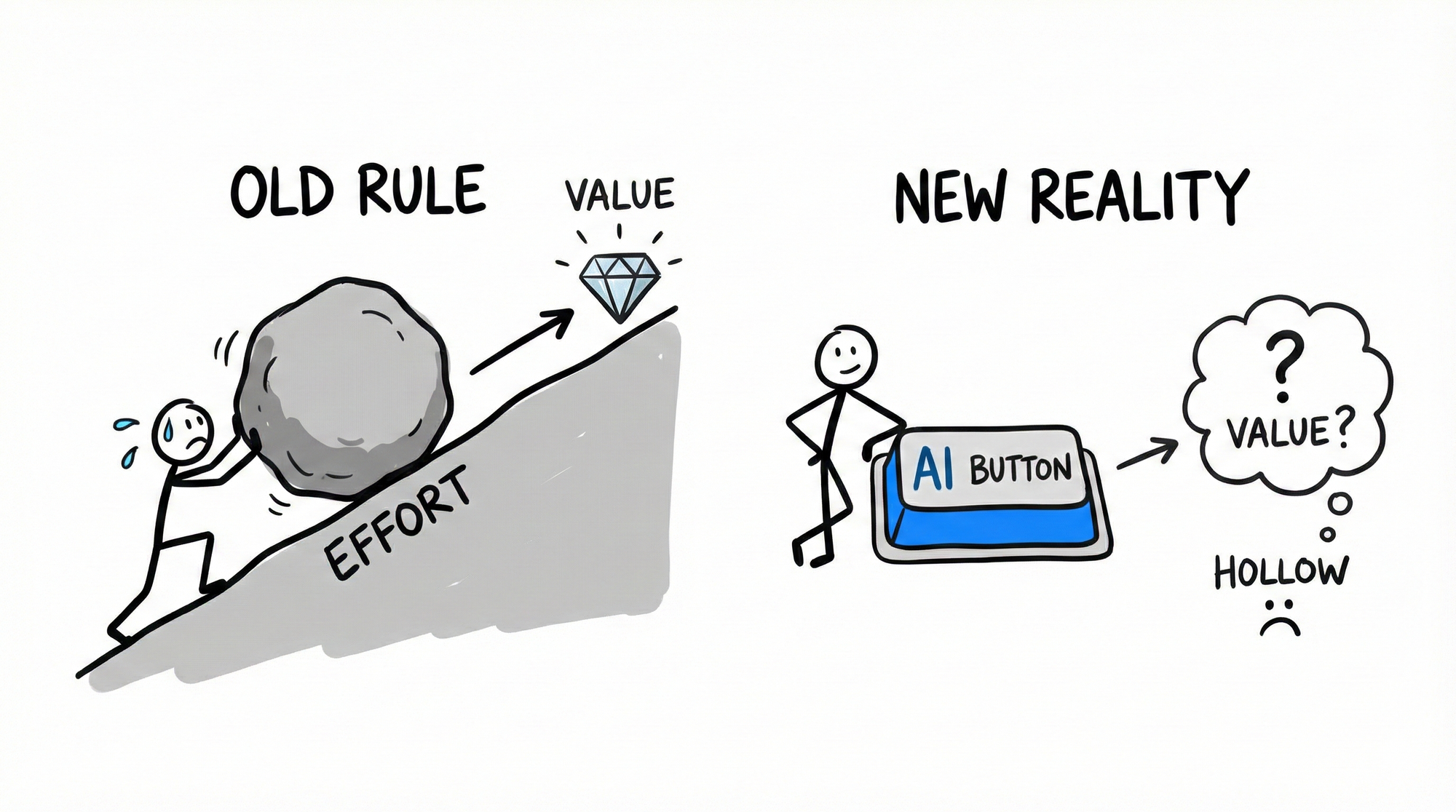
AI inverts this.
The same output that once required expertise now requires a prompt. The same analysis that took a team weeks now takes an afternoon. The same creative work that separated professionals from amateurs now flows from anyone with access.
The quality might be equivalent. The effort is not.
And humans, it turns out, care about the effort.
Why Effort Matters
This isn't irrational.
Effort carries information. When someone spends years mastering a craft, that investment signals:
- They care about quality (or they wouldn't invest)
- They've developed judgment (through repetition)
- They'll notice mistakes (because they've made them)
- They understand exceptions (because they've encountered them)
When a doctor diagnoses you after decades of training, you're buying their accumulated judgment, not just the diagnosis.
When the diagnosis comes from a button press, what are you buying?
The Meaning Crisis
Here's where it gets psychological.
Humans derive meaning from challenge. Flow states emerge at the intersection of high skill and high challenge. Satisfaction comes from overcoming difficulty. Identity forms around what we struggled to achieve.
Remove the struggle, and meaning evaporates.
The producer didn't just lose the song's value to others. He lost his reason for making it. If the button makes the beat, why is he the producer?
This is the Meaning Crisis Spiral:
AI does creative work → Effort no longer signals value
→ Purpose erodes → Button-pushing increases
→ Authenticity questioned → More meaning lost → [cycle continues]
Each press of the button makes the next press feel more necessary and less satisfying.
The Three Responses
People respond to the Button Problem in three ways:
1. Denial
"My work is different. AI can't do what I do."
This works until it doesn't. The jagged frontier is moving. What AI couldn't do last year, it does this year. Denial is a delay, not a solution.
2. Despair
"If AI can do it, what's the point?"
This is the Meaning Crisis in full bloom. The producer's hollowness. If effort doesn't matter, does anything?
3. Redefinition
"My value isn't in the output. It's in what I bring that the button can't."
This is the path forward. But it requires identifying what that "what" actually is.
What the Button Can't Do
The button generates. But generation isn't the whole job.
What the button can't do:
Frame the problem. AI answers questions. Humans decide which questions matter. The prompt is upstream of the output. Better prompts create better outputs. The framing skill becomes more valuable, not less.
Evaluate the output. AI generates options. Humans judge which option fits this situation, this client, this moment. Evaluation requires context the button doesn't have.
Take responsibility. When the output fails, someone has to answer for it. The button won't explain itself in court. The button won't rebuild trust with a client. The button can't be held accountable.
Connect meaning. Humans care why something was made. A song written for a dying parent carries weight a generated track doesn't. Meaning is human-assigned. AI has no stake in it.
The New Creative Identity
The producers who survive the Button Problem don't get there by rejecting the button. They get there by redefining what they do.
Old identity: "I make beats." New identity: "I curate, sequence, and contextualize sound."
Old identity: "I write copy." New identity: "I understand what this audience needs to hear and ensure the message delivers it."
Old identity: "I design graphics." New identity: "I translate brand strategy into visual systems that work across contexts."
The shift: From production to curation. From generation to judgment. From output to meaning.
The Discipline Required
Here's the catch: redefinition requires discipline.
The button is always easier. Pressing it first, then editing, feels efficient. But every time you press before framing, you weaken the framing muscle. Every time you accept before evaluating, you atrophy the evaluation skill.
Path A (human frames first) preserves the skills that make you irreplaceable.
Path B (button first, edit after) erodes them.
The Button Problem isn't about whether to use the button. It's about when.
Frame first. Evaluate seriously. Know why you're pressing. Then press.
That's how the button becomes a tool instead of a replacement.
The Standard
The button is here. It's not leaving. The work is no longer defined by the output it produces.
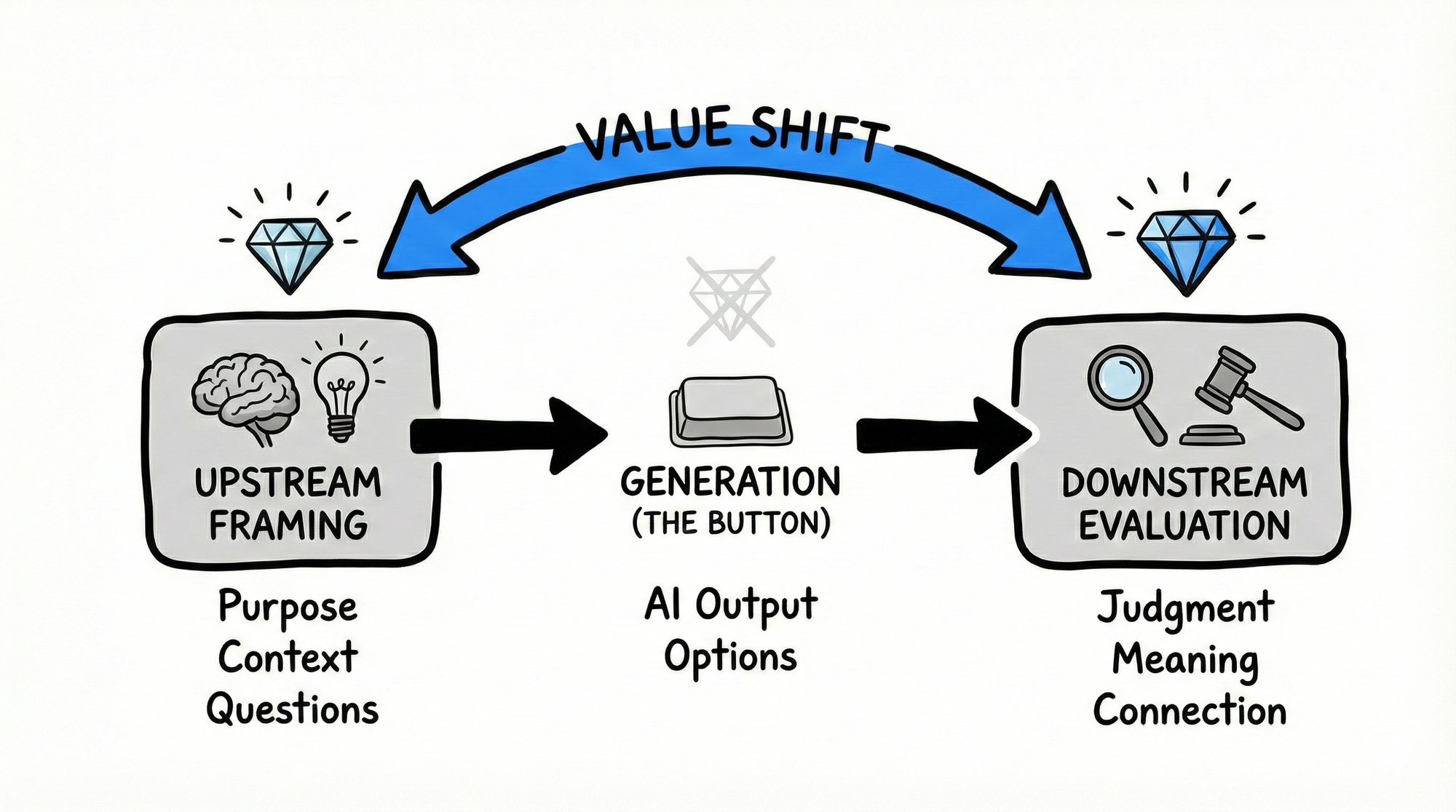
Your value now lives upstream (in the framing) and downstream (in the evaluation and meaning-making).
The producer who can't articulate why his AI-generated beat matters will lose to the producer who can. Not because the beats are different. Because the story around them is.
Effort still signals value. It just signals in different places now.
The question isn't whether you can press the button.
It's whether you know what the button can't do, and whether you're building those muscles deliberately.
"If generating something takes no effort, what signals that it has value? The answer: everything that happens before and after you press the button."
This post explores the Meaning Crisis, a Path B consequence from The Context Flow. When creation is easy, effort stops signaling value.