
The Missing Middle
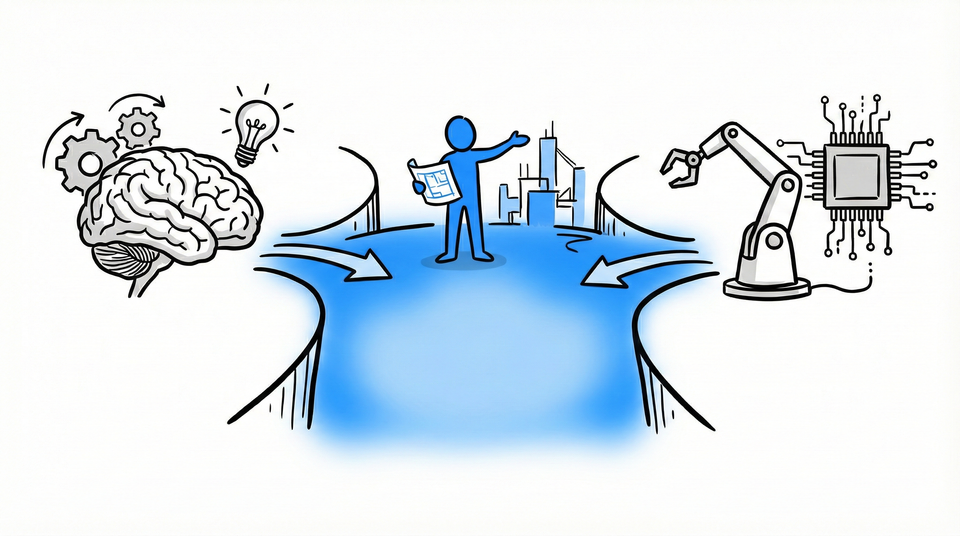
AI didn't just eliminate jobs. It created work that couldn't exist before. The question is whether you can see it.
The Prompt Engineer Who Wasn't
In 2022, a new job title started appearing on LinkedIn: Prompt Engineer.
The skeptics laughed. "Getting paid to talk to a chatbot? That's not a real job."
The skeptics were right. And completely wrong.
They were right that "prompt engineer" as initially conceived was a transitional role. Learning to phrase questions effectively isn't a long-term skill. The models get better at understanding bad prompts.
But they missed the bigger point.
Something real was emerging. Not the job title. The job category.
People who could bridge the gap between what AI could theoretically do and what organizations actually needed. Who could translate business problems into AI workflows. Who could spot when the output was subtly wrong in ways that mattered.
These people weren't doing work that used to be done by humans. They were doing work that couldn't exist before.
This is the Missing Middle.
What the Missing Middle Is
The naive story about AI and jobs has two options: automation or nothing.
Either AI replaces what humans did, or it doesn't. Binary. Zero-sum.
The naive story misses the third category: work that wasn't possible before.
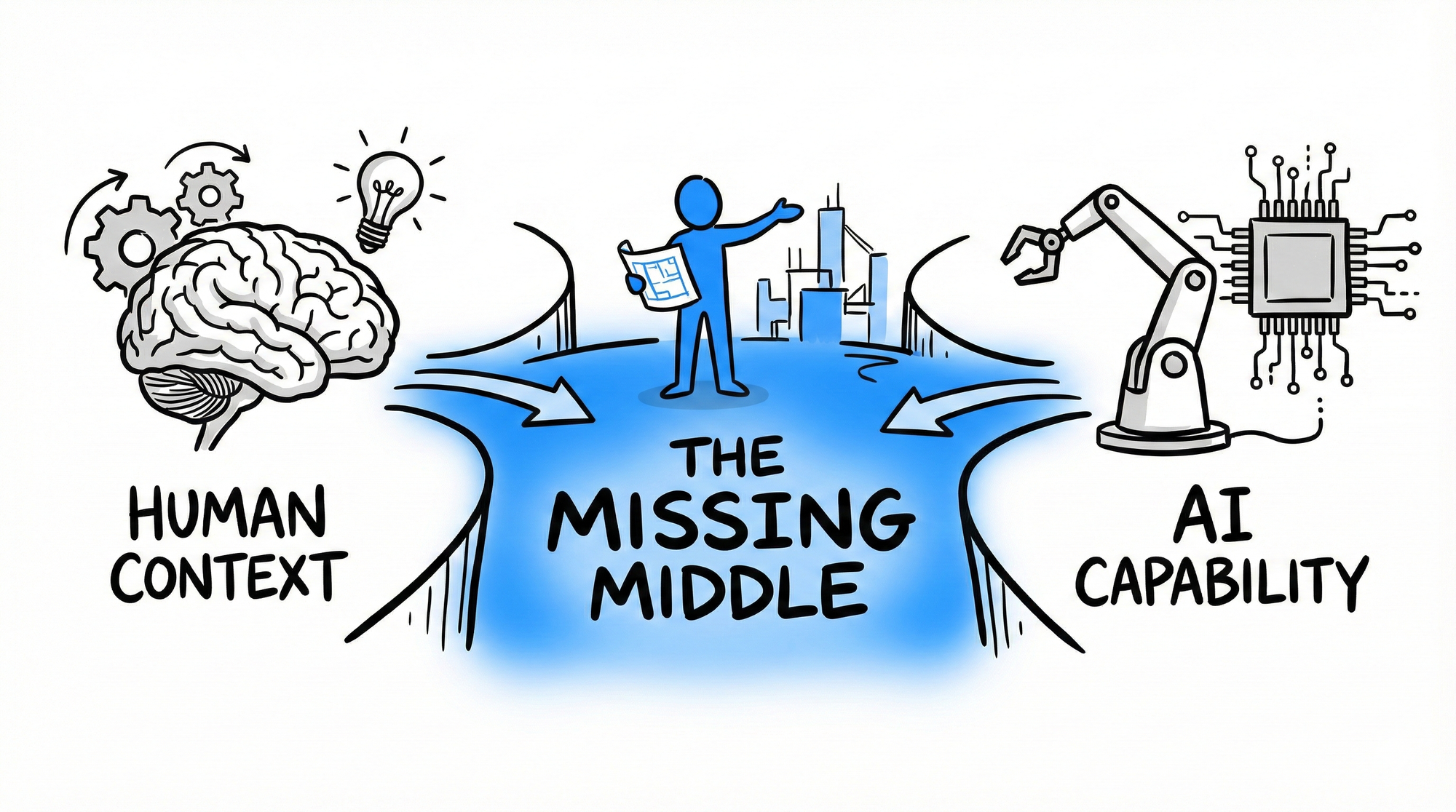
The Missing Middle is: Net new value created when human context combines with AI capability in ways that produce outcomes neither could achieve alone.
Not faster versions of old work. New work.
Where It Appears
In healthcare:
A radiologist using AI can now review population-level data that would take a human lifetime to analyze. Not reading more scans. Finding patterns across millions of scans that reveal risk factors no individual doctor could notice.
The work isn't "faster radiology." It's "population health insight generation." That job didn't exist.
In law:
A lawyer with AI assistance can now offer contract review to small businesses that couldn't afford legal help before. Not cheaper legal work. Newly accessible legal work.
The paralegal who before researched cases now reviews and corrects AI research, training the system while serving more clients. Not the same job faster. A different job entirely.
In education:
A teacher with AI can now provide personalized learning paths for thirty students simultaneously. Not teaching faster. Teaching in a way that was physically impossible with one human and thirty learners.
The work of "personalized curriculum delivery at scale" couldn't exist with human labor alone.
In design:
A designer with generative AI can now explore ten thousand variants before breakfast. Not faster iteration. Exploration of design space that no human could traverse manually.
The work of "comprehensive design space exploration" is new work.
Why Organizations Miss It
If the Missing Middle creates value, why don't more organizations find it?
Three reasons:
1. They're looking for replacement, not augmentation
When organizations evaluate AI, they ask: "What jobs can this replace?"
That question blinds them to: "What work can this enable?"
Replacement is visible. New work is invisible until someone creates it.
2. The expertise requirement
Finding the Missing Middle requires deep domain knowledge. You have to understand what was impossible before to recognize what's possible now.
Organizations that cut experts to save costs lose the people who could find the new value.
3. The measurement problem
How do you measure work that didn't exist?
There's no baseline. No "before" to compare to. The productivity gains are invisible to traditional metrics.
Organizations optimizing for measurable efficiency miss the unmeasurable innovation.
The Pattern
The Missing Middle appears at the intersection of three conditions:
- Human context is essential - The work requires judgment, domain knowledge, or meaning-making that AI can't provide
- AI capability is essential - The work requires scale, speed, or pattern-matching that humans can't provide
- Neither could do it alone - The work isn't a faster version of human work or a cheaper version of AI work
When all three conditions hold, you're in the Missing Middle.
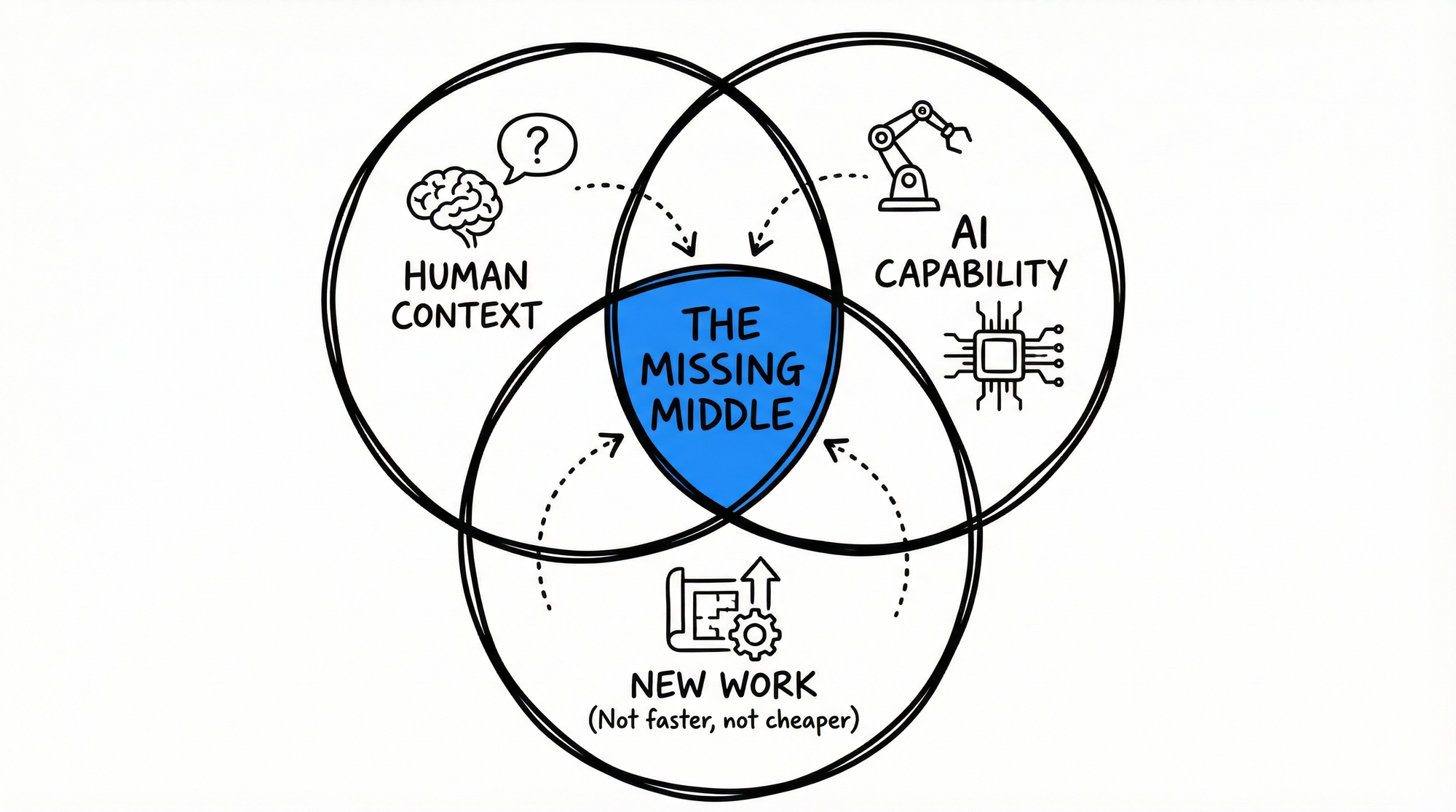
When any one is missing, you're either doing human work with AI assistance (Path A) or AI work with human acceptance (Path B).
Both of those are fine. But neither is the Missing Middle.
Finding It In Your Work
The Protocol:
- List tasks that feel impossible or impractical today
- For each: What makes it impossible?
- Ask: Could AI remove that specific barrier?
- If yes: What human input would still be required?
- If human input is essential: You've found potential Missing Middle
Examples:
"I can't analyze every customer conversation - too many." → AI can process volume → Human judgment needed for meaning → Missing Middle: Pattern discovery across all customer conversations
"I can't offer personalized recommendations - takes too long." → AI can generate options at scale → Human curation of quality → Missing Middle: Curated personalization at scale
"I can't test every variant - design space is infinite." → AI can explore options → Human judgment on what matters → Missing Middle: Comprehensive design exploration with taste
The Economic Opportunity
Organizations that find the Missing Middle don't just gain efficiency. They create new value.
This is why Path A organizations outperform Path B in the long run.
Path B optimizes existing work. Costs drop. But so does differentiation. You're racing competitors to the bottom of the same well.
Path A finds new work. Value increases. Differentiation grows. You're reaching markets and capabilities that didn't exist.
The Missing Middle is where Path A leads that Path B can never reach.
The question isn't whether AI will eliminate jobs. Some jobs will be automated. That's happening.
The question is whether you can see the jobs AI creates. The new work. The impossible-before work. The work that exists in the gap between human context and AI capability.
That's the Missing Middle.
It's only visible if you're looking for it.
"AI didn't just automate old work. It enabled new work. The organizations that thrive won't be the ones that cut costs. They'll be the ones that found what couldn't exist before."
This post explores the Missing Middle, Path C territory from The Context Flow. Not faster work. New work.