
Use It or Lose It
Skills you don't practice atrophy. This isn't metaphor. It's neuroscience. And AI makes the atrophy invisible.
The Surgeon Who Stopped Operating
In 2019, a senior surgeon at a major hospital made an unusual request.
He asked to be removed from the surgical rotation.
Not because of burnout. Not because of age. Because he'd noticed something happening to his hands.
For two years, he'd been supervising residents instead of operating. Teaching instead of doing. Reviewing instead of performing.
When he finally stepped back into the OR for an emergency case, his hands weren't the same.
The movements that had been automatic now required thought. The judgment calls that had been instant now felt uncertain. The confidence that had been bone-deep now wavered.
He hadn't forgotten how to operate. He'd lost the automatic fluency that made operating feel natural.
Two years of supervision without practice. That's all it took.
The Neuroscience Is Clear
Use-dependent plasticity is the formal name.
Your neural pathways strengthen with use and weaken without it. The brain is efficient. It doesn't maintain capacity you're not using.
This isn't gradual over decades. It's measurable within months.
Expert musicians who stop playing show degraded fine motor control within weeks. Chess grandmasters who stop competing show slower pattern recognition within months. Radiologists who stop reading scans show increased error rates within a year.
The expertise you built through thousands of hours of practice requires ongoing practice to maintain.
Stop using it and it atrophies. Invisibly at first. Then suddenly.
AI Accelerates the Atrophy
Here's where AI creates a new kind of trap.
Before AI, stopping practice was obvious. The surgeon who supervised instead of operating knew he wasn't operating. The choice was visible.
With AI, the atrophy is hidden inside apparent work.
The writer who uses AI for first drafts is still writing. But the muscle that generates original prose isn't being exercised.
The analyst who uses AI for data synthesis is still analyzing. But the pattern recognition that spots unusual signals isn't being trained.
The lawyer who uses AI for contract review is still reviewing. But the judgment that catches subtle liability isn't being developed.
The work looks the same. The skill exercise is gone.
This is why Path B creeps up invisibly. You feel productive. You are productive, in some sense. But the expertise that makes you irreplaceable is quietly eroding.
The Lazy Cognition Spiral
Daniel Kahneman's research on cognitive ease explains the mechanism.
When a task becomes easy, the brain shifts to automatic processing. Less effort, less engagement, less learning.
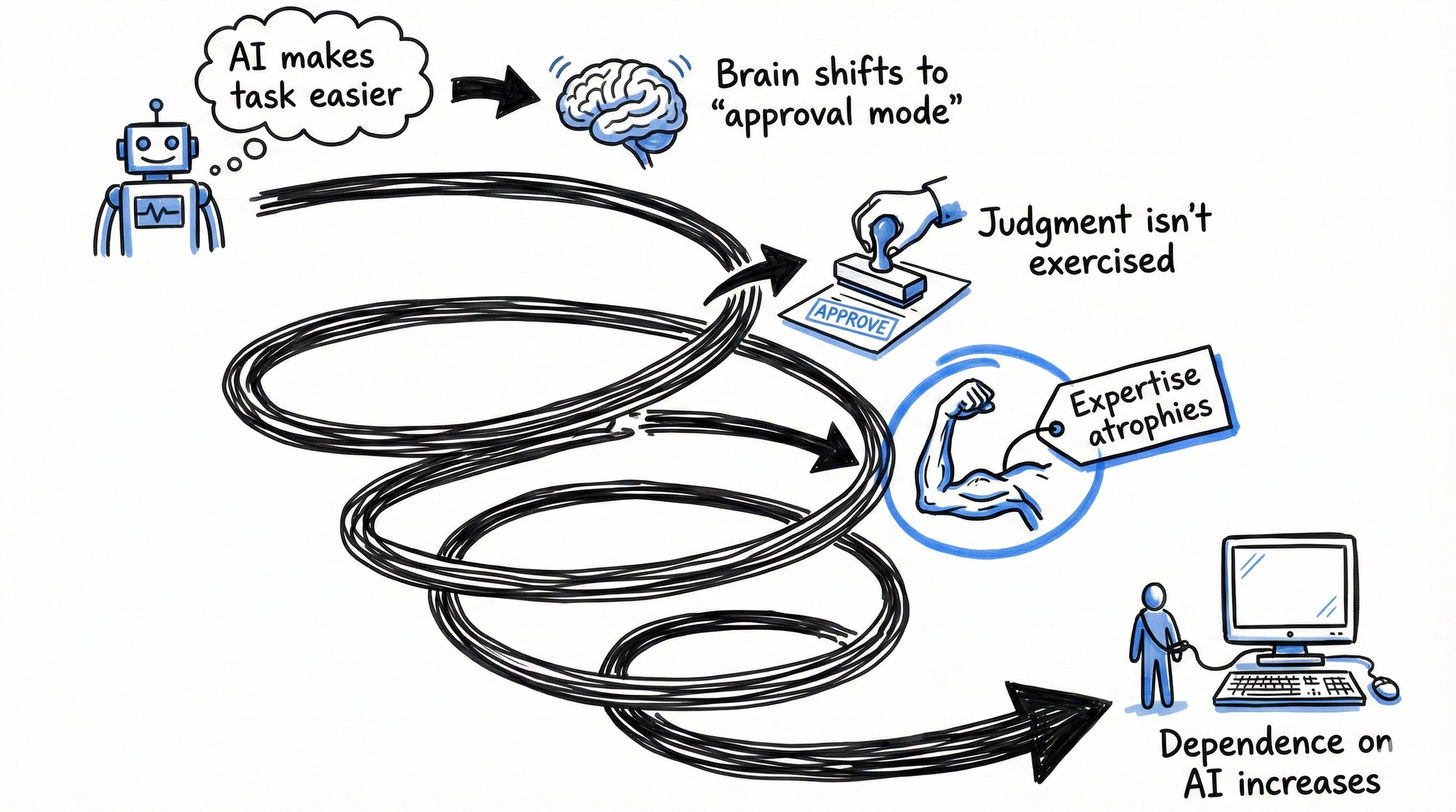
AI makes tasks easy. That's the value proposition.
But easy tasks don't build expertise. They let expertise atrophy.
The spiral:
- AI makes task easier
- Brain shifts to "approval mode" instead of "creation mode"
- Judgment isn't exercised
- Expertise atrophies
- Errors become harder to catch
- Dependence on AI increases
- More tasks shift to AI
- More expertise atrophies
Each loop is invisible. The degradation only becomes apparent when you try to do something without AI and realize you can't.
The Entry-Level Collapse
The atrophy isn't just individual. It's organizational.
Entry-level roles are where expertise gets built. The junior lawyer who reviews contracts learns to spot issues. The junior analyst who builds models learns to question data. The junior designer who iterates learns to see what works.
When AI handles entry-level work, the pipeline breaks.
Not immediately. The senior people still have their expertise. But juniors aren't building the skills that would make them senior.
Fast forward five years: the seniors retire or leave. No one who learned the fundamentals is ready to replace them.
The organization realizes it can't supervise the AI anymore because the supervisors are all gone.
This is use-it-or-lose-it at the institutional level. And it takes years to become visible.
The Warning Signs
Individual:
- You feel uncomfortable doing work without AI assistance
- Tasks that used to be automatic now require deliberate effort
- You can't remember the last time you created something from scratch
- Your instinct for quality has become uncertain
Organizational:
- Senior people are overwhelmed with supervision
- Training programs feel less effective
- Time-to-competency is increasing
- Expert departure creates larger gaps than before
The test: Set aside AI for a day. Do your core work the old way.
If it feels foreign, the atrophy has begun.
Recovery Protocol
The good news: expertise atrophy is reversible. The bad news: it takes deliberate effort.
1. Identify Core Skills
Not everything needs protection. Identify the judgment calls and creative capabilities that define your value.
2. Mandatory Practice Windows
Block time where AI is off. Do the core work manually. Not to be more productive. To maintain capability.
3. Deliberate Difficulty
AI makes work easy. Deliberately choose hard versions. Write without assistance. Analyze without automation. Create from blank pages.
4. Teach to Learn
Teaching forces you to articulate what you know. It exercises judgment in a way passive work doesn't. Mentor junior people. Explain your reasoning out loud.
5. Rotation Schedules
Organizations can build expertise maintenance into roles. Rotations that require hands-on work. Projects that can't use AI. Deliberately inefficient learning experiences.
The Discipline
The surgeon who requested removal from rotation made the wise choice. He saw the atrophy before it became dangerous.
Most people don't see it.
The expertise feels stable. The work feels productive. The AI handles everything.
Until the day you need your skills and they're not there.
Path A maintains expertise because humans lead. The act of framing problems, evaluating outputs, and making judgment calls exercises the capabilities that matter.
Path B erodes expertise because humans follow. The act of approving outputs, accepting generations, and rubberstamping results lets capability atrophy.
Same technology. Opposite trajectories.
The difference is whether you're using your judgment or losing it.
"The skills you don't practice atrophy. This isn't metaphor. It's neuroscience. AI makes the atrophy invisible. By the time you notice, you've already lost what you can't get back quickly."
This post explores expertise atrophy, the core danger of Path B from The Context Flow. The skills you don't use disappear.