
Why Platforms Always Win at Attribution
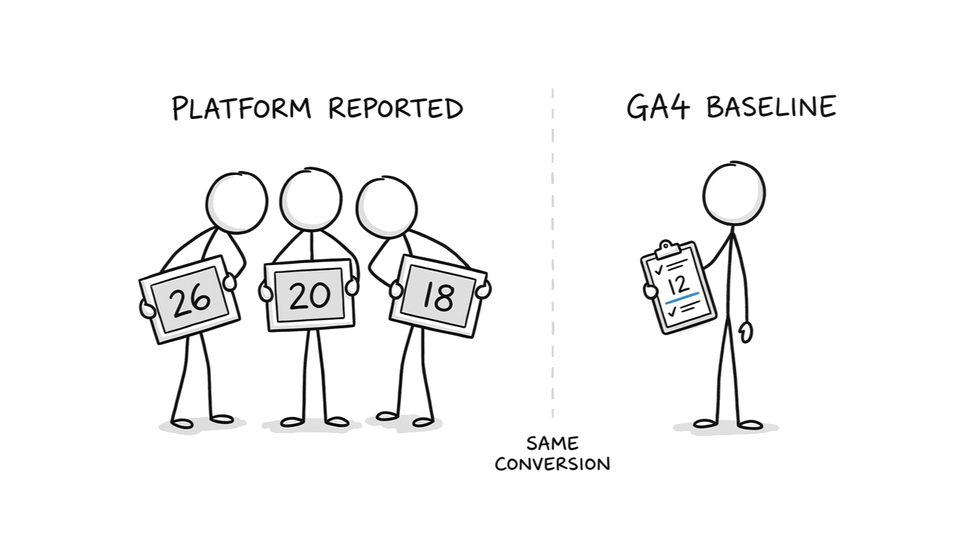
- Platform conversion discrepancy is structural, not a tracking error. Each platform's default attribution window is calibrated to maximize its own credit, not to measure objectively.
- GA4 underreports paid campaign conversions by 18-35% when cookies are blocked, but it has no revenue incentive to overcount. That makes it the only independent baseline in multi-platform reporting.
- A 20-30% Meta/GA4 conversion discrepancy is within normal range. Use GA4 for leadership reporting and each platform's native conversion data for platform-level optimization.
You've tried to fix it. You aligned attribution windows. You enabled enhanced conversions. You added server-side tags. The numbers still don't match.
Platform conversion discrepancy is structural accounting, not broken tracking. Each platform counts the same user action from its own ledger, using windows it set to maximize its own credit. The mismatch was not introduced by your setup. It was shipped by the platforms.
Platform Attribution Windows Count in Their Own Favor
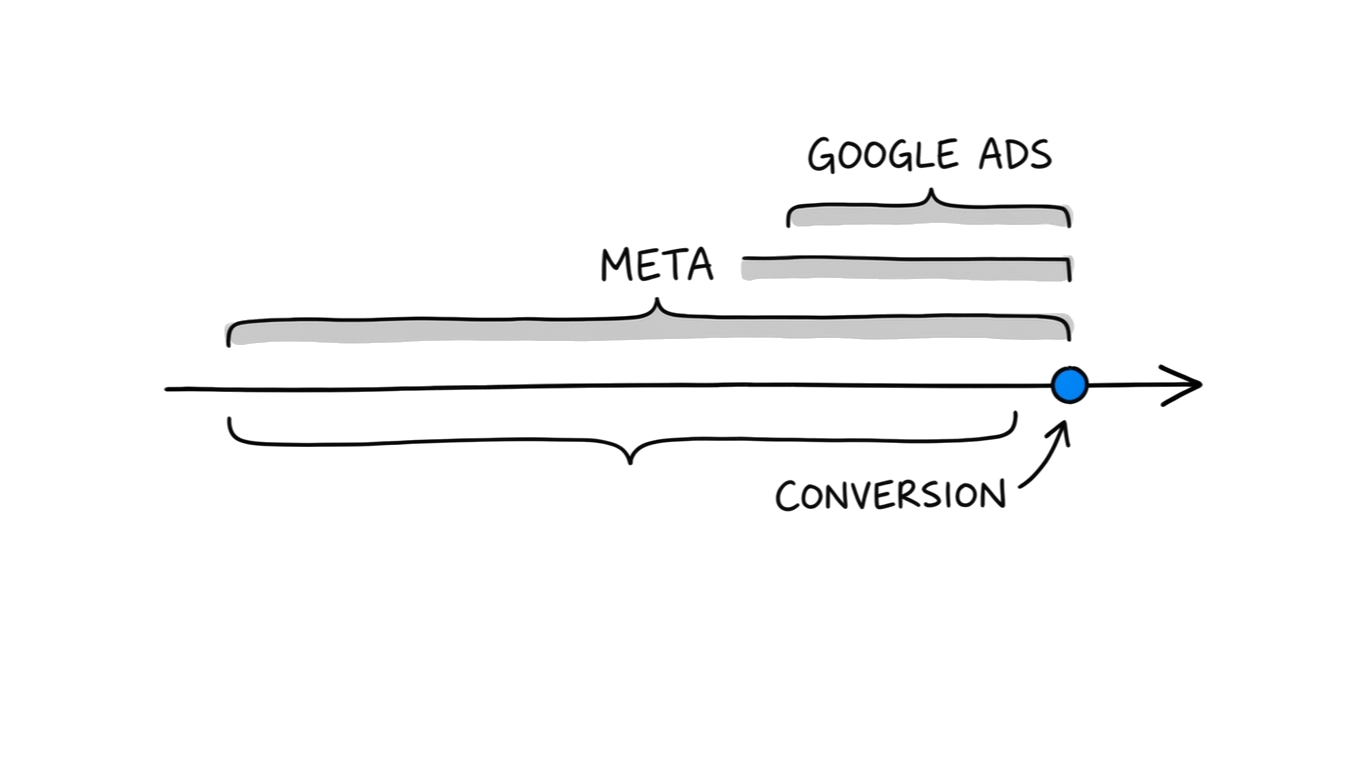
Platform conversion discrepancy starts here: every platform's default attribution window is the one that gives it the most credit.
Platform attribution window is the time period in which a platform claims credit for a conversion after a user interacts with an ad. Meta's default is 7-day click / 1-day view. A purchase that happens six days after a click and 18 hours after a video view gets counted in both models. Google Ads defaults to last-click or data-driven, using only Google-owned touchpoints.
Neither window was designed to be neutral. Both were designed to be generous.
Varos's 2024 industry benchmark data puts Meta's reported conversions an average of 26% above what third-party analytics tools record. Google Ads with Enhanced Conversions enabled runs 15-20% above GA4, per Google Ads documentation. That gap is not random. It is the predictable output of every platform counting conversions from its own corner.
For the specific mechanics of how the google ads ga4 discrepancy develops at the campaign level, that piece covers the breakdown in detail.
GA4 Is the Only Referee Without Skin in the Game
GA4 undercounts. That is the first thing to say about platform conversion discrepancy.
GA4 underreports paid campaign conversions by 18-35% when cookies are rejected, according to Cardinal Path's 2024 GA4 analysis. That range is wide and real. If you are looking for an accurate count of every conversion that happened, GA4 is not giving you that either.
But the question is not which tool counts highest. The question is which tool has no financial incentive to count in its own favor.
GA4 does not sell ads. It has no revenue incentive to show more conversions. Every platform reporting conversions to you does. As Jeff Sauer has framed it: each ad platform tells a self-serving story. GA4 is the only cross-reference that shows where that story inflates.
GA4 has an accuracy problem. The ad platforms have an incentive problem. Those are two different categories of error. For leadership reporting, the incentive problem is the one that shapes the number you defend.
GA4 underreports conversions by 18-35% when cookies are rejected. Every ad platform overreports by design. The question is not which number is right. It is which number has no skin in the game.
What a Normal Discrepancy Range Looks Like
Platform conversion discrepancy becomes a problem when practitioners don't know where normal ends.
Normal looks like this: Meta running 20-30% above GA4 for the same campaign period is expected. Google Ads running 15-20% above GA4 is expected. A discrepancy within those ranges is not a tracking failure. It is the structural math of different attribution models counting the same conversions from different vantage points.
The flag is when the platform conversion discrepancy moves outside those ranges or spikes suddenly.
Investigate when:
Platform conversion discrepancy between Meta and GA4 exceeds 40% consistently
Google Ads platform conversion discrepancy above GA4 runs above 25% after a configuration change
A stable platform conversion discrepancy pattern shifts sharply without a corresponding change in campaign type or volume
These thresholds reflect observed patterns in multi-platform accounts. No published benchmark defines them. They are practitioner rules calibrated against the normal ranges above.
Three triggers that legitimately move the discrepancy range: a new campaign type launch, a recent attribution window update, or a shift in audience targeting method. The meta attribution window change in 2026 moved the expected Meta/GA4 platform conversion discrepancy range for many accounts. The baseline shifted. The tracking did not break.
The Number to Defend When Platforms Disagree
Most practitioners report the platform number that wins the room.
Meta up 40% this week? Lead with Meta. GA4 showing a conversion drop? Find a platform metric that does not. This is not dishonesty. It is what happens when there is no consistent baseline and every number is negotiable.
Platform conversion discrepancy becomes a leadership problem when the number you report changes based on which platform had a good week.
Use GA4 as the baseline for internal and leadership reporting. Use each platform's native conversion data for platform-level optimization only.
Why GA4 for the leadership number: leadership needs a figure that does not change when a platform adjusts its attribution model. Meta changed its default windows in 2026. Google periodically updates its data-driven model. When those changes happen, platform-reported conversions shift. GA4's count does not move in response to what a platform decides to credit itself.
This is not an argument that GA4 is right. It is an argument that GA4 is consistent and independent. Consistent and independent beats accurate-but-adjustable for leadership reporting every time.
For optimization, use each platform's native data. Google's Smart Bidding algorithm uses Google conversion signals, not GA4 events. Meta's delivery optimization runs on Meta pixel data. Feeding GA4 numbers into platform bidding fights the system you are paying to run. The separation is clean: GA4 for the scoreboard, platform data for the engine.
Stop.
You are allowed to stop reconciling.
The gap between Meta and GA4 will not close. The gap between Google Ads and GA4 will not close. Understanding why removes the obligation to fix it.
Use GA4 as the consistent baseline for leadership reporting. Use each platform's native conversion data for optimization. You do not need the platforms to agree. You need to know which number you are defending and why.
That is the whole job.