
Reading What's Really There

Three documents reveal your real strategy: the budget, the calendar, and the promotion list.
Open your calendar for last month. Count the hours. Where did they actually go?
Now open your credit card statement. What did you actually spend money on?
Compare those two documents to your goals list. Your stated priorities. Your New Year's resolutions.
The gap between those documents is your revealed strategy.
Not what you say matters. What actually gets your time and money.
Peter Drucker had a simple diagnostic for executives.
He'd ask them to estimate how they spent their time. Then he'd have them track it for a week.
The estimates were always wrong.
Leaders who said they spent 40% of their time on strategy spent 8%. Leaders who said they avoided administrative work spent 60% there. Leaders who claimed to prioritize people development spent almost no time on it.
The calendar didn't lie. The self-perception did.
Drucker's insight: You can't manage what you don't measure. And you can't measure what you won't face.
The Revealed Strategy Audit has three documents:
The Budget: Where money actually goes
The Calendar: Where time actually goes
The Promotion List: What behavior actually gets rewarded
Everything else is narration.
Reading the Budget
Clayton Christensen's insight cuts to the heart of this: "Where money goes, strategy follows."
Not as metaphor. As mechanism.
The proposals that get funded might succeed. Everything else starves. Resource allocation IS strategy.
Xerox PARC invented the graphical user interface, the mouse, ethernet, and laser printing. All in the 1970s. The research budget said "innovation is our future."
But when it came time to commercialize, the money went elsewhere. Xerox protected copiers.
Steve Jobs visited PARC in 1979, saw the future, and built it. The Macintosh shipped in 1984.
Xerox's R&D budget told one story. Their commercialization budget told the truth.
The diagnostic questions:
What got cut last budget cycle?
That's what's actually dispensable, regardless of what the strategy deck says.
What always gets funded, even in tight years?
That's the real priority, regardless of the org chart.
Where does discretionary spending go?
That's what leadership actually values, regardless of the mission statement.
The budget is a strategy document. Most organizations just don't read it that way.
Reading the Calendar
When Marissa Mayer became Yahoo's CEO in 2012, she declared innovation and collaboration as top priorities.
Her first major act? Banning remote work. Everyone in the office.
Then the meetings multiplied. Engineers reported calendars so packed they had no time to actually build anything.
Yahoo said it wanted to move fast. The calendar revealed a company that had institutionalized slowness.
The diagnostic questions:
Where does the CEO's calendar actually go?
That's what leadership actually values, regardless of the all-hands speech.
What meetings are non-negotiable vs. easily rescheduled?
That's the revealed hierarchy of importance.
Who gets face time and who gets email?
That's the actual org chart, regardless of the official one.
The calendar is a values document. It shows what you protect when everything competes for attention.
Reading the Promotion List
Microsoft under Steve Ballmer explicitly valued teamwork. The company's leadership principles emphasized collaboration.
Yet their stack ranking system forced managers to rate employees against each other on a bell curve. Someone had to lose.
A 2012 Vanity Fair investigation found engineers actively sabotaging colleagues, refusing to share code, avoiding talented team members who might outshine them.
The values poster said collaboration. The promotion system said compete or die.
The diagnostic questions:
Who actually got promoted in the last year?
That's what behavior gets rewarded, regardless of the performance review criteria.
What's the common pattern among the promoted?
That's the actual culture, regardless of the stated values.
Who left and why?
That's what the organization actually punishes, regardless of the retention strategy.
The promotion list is a culture document. It shows what behavior survives and what doesn't.
Running the Audit
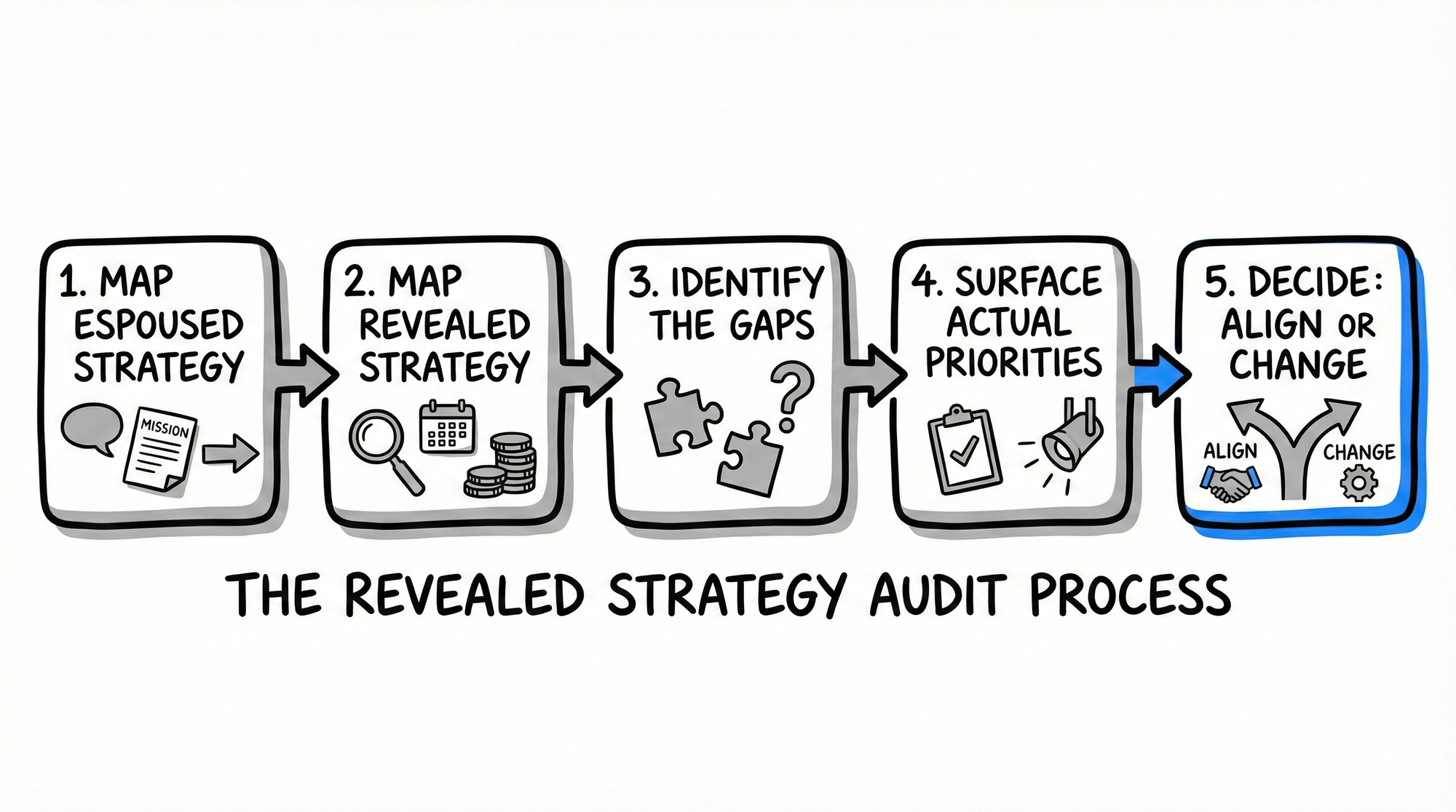
Step 1: Map Espoused Strategy
Gather your stated priorities: strategy decks, mission statements, OKRs, values posters. What you SAY matters.
Step 2: Map Revealed Strategy
Gather your actual behavior: last quarter's budget, last month's calendar, last year's promotions. What you actually DO.
Step 3: Identify the Gaps
Where espoused ≠ revealed. What you say is a priority but gets no budget? What you claim to value but gets no calendar time? What behavior you say you reward but doesn't get promoted?
Step 4: Surface Actual Priorities
Name what the revealed strategy actually is. Not what you wish it was. Not what it should be. What it actually is, based on behavior.
Step 5: Decide: Align or Change
Two options: Update your espoused strategy to match reality (be honest about what you actually value). Or change your behavior to match your espoused strategy (put time/money where your mouth is).
Both are valid. Pretending there's no gap is not.
The Wells Fargo Example
At Wells Fargo, the answers would have been clear years before the scandal:
What got cut? Ethics training, customer service time
Where did calendars go? Sales meetings, target reviews
Who got promoted? Top sellers, regardless of method
What survived? Sales targets
What happened under pressure? Fraud
The execution was revealing the strategy the entire time.
Leadership just wasn't reading it.
You don't need insider access to know an organization's real strategy.
You just need to know where to look.
Three documents tell you everything: the budget, the calendar, and the promotion list.
Everything else is narration.
This post explores the Revealed Strategy Audit, the practical application of Execution Reveals. The four forces explain WHY execution reveals strategy. This shows you HOW to read it.