
The Information Flow
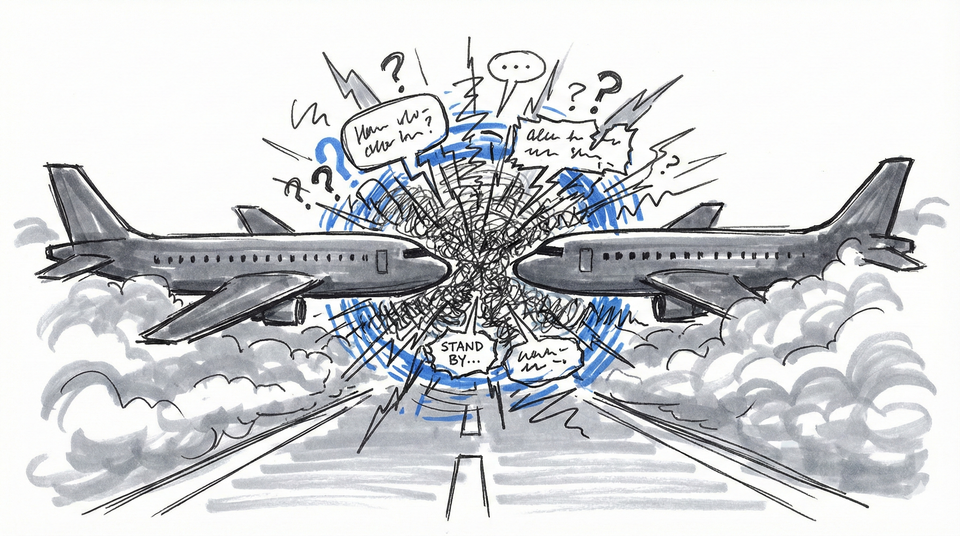
Why Account Management succeeds or fails at information flow, not relationship warmth.
The Three-Second Silence
On March 27, 1977, fog rolled across Los Rodeos Airport in Tenerife.
Two Boeing 747s sat on the same runway. KLM Flight 4805 at one end, engines running. Pan Am Flight 1736 still taxiing toward an exit they couldn't see in the murk.
At 5:06 PM, the KLM first officer radioed the tower: "We're now at takeoff."
It was meant as a statement. We are beginning our takeoff roll.
The tower heard something else. A request. And responded: "Okay... stand by for takeoff, I will call you."
At that exact moment, Pan Am's copilot keyed his radio: "We're still taxiing down the runway!"
Both transmissions hit the airwaves simultaneously.
The result was a three-second heterodyne. A shrill electronic squeal that blocked out everything except the first word.
The KLM captain heard: "Okay..."
He didn't hear: "...stand by for takeoff."
He didn't hear: "...still taxiing down the runway."
He released the brakes.
Twelve seconds later, the KLM 747 was hurtling through the fog at 160 mph. The Pan Am crew saw landing lights bursting through the white. Captain Victor Grubbs slammed the throttles forward, trying to turn off the runway.
He almost made it.
583 people died. The deadliest accident in aviation history.
Everyone Had the Information
Here's what makes Tenerife unbearable:
Every person in that sequence had the information someone else needed.
The tower knew Pan Am was still on the runway. Pan Am knew they hadn't exited. KLM's flight engineer even asked: "Is he not clear, that Pan American?"
The captain said: "Oh yes."
He was wrong. But he wasn't lying. He genuinely believed it.
The information existed. It just didn't flow.
Three seconds of overlapping radio transmissions. Three seconds of electronic noise where there should have been human voices. Three seconds that separated "stand by" from "okay."
The handoff failed in the air itself.
This Is Information Flow
The Tenerife disaster wasn't caused by incompetent pilots. KLM's captain, Jacob van Zanten, was one of the most experienced in the world. He was literally the face of KLM's safety training program.
It wasn't caused by bad intentions. Every person in that sequence was trying to do their job.
It was caused by information that existed but didn't survive the handoff.
Success happens in the handoffs, not the heroics.
When the right information reaches the right person at the right time, things work.
When it doesn't, even the most capable people make catastrophic decisions. Not because they're careless. Because they're operating on incomplete data.
This isn't about working harder. You're not failing because you don't care enough or aren't smart enough. You're failing because the system doesn't have the right plumbing. Fix the plumbing, and your existing effort starts working.
What This Means for You
If you manage client relationships, you sit at the center of multiple handoffs.
Sales hands you a client. You hand context to execution teams. Teams hand deliverables back to you. You hand updates to leadership. Clients hand you information that has to reach people who've never met them.
Each handoff is a potential Tenerife.
Not in stakes. In structure.
Information exists on one side. It needs to reach the other. Something in between can garble it, delay it, or block it entirely.
The fire drill you're managing right now? Trace it back. At some point, someone had information that someone else needed. The handoff failed.
Two Engines, Two Outcomes
Information Flow isn't one thing. It's two.
| Engine | Components | Purpose |
|---|---|---|
| Performance Engine | Story Anchor + Gates | Information fidelity (delivering the right work) |
| Perception Engine | Story Stream | Trust through narrative (making progress visible) |
Both engines create trust. Both drive retention.
The Performance Engine earns trust by delivering what you promised. The Perception Engine earns trust by making the journey visible.
Get performance right without perception, and clients leave the moment a cheaper option appears. They don't see the value you've created. Get perception right without performance, and trust erodes when results don't materialize.
You need both engines running.
Engine 1: Story Anchor + Gates (Performance)
The Story Anchor: Capture the Quest
At Tenerife, Pan Am's position was known to people the KLM crew couldn't hear.
The tower knew. Pan Am's copilot knew. The information was in the system.
It just wasn't in the KLM cockpit.
This is the problem you solve with a Story Anchor.
Think about what happens without one:
You have a discovery call with the client. You understand why they hired you, what success looks like, what's out of scope. That conversation lives in your head.
Then the SEO team asks: "What should we optimize for?"
You answer. But you're translating from memory. Context gets lost.
Then the content team asks: "What tone should we use?"
You answer again. More context lost.
Then the PPC team asks: "What's our target CPA?"
Each team gets a fragment. No one gets the whole picture.
The client's actual question gets diluted across every handoff.
Just like Pan Am's position got diluted across the radio.
What the Story Anchor Does
The Story Anchor is a document that travels with the work.
It captures:
- SITUATION: Where the client is now
- COMPLICATION: What's blocking them
- QUESTION: The real strategic question they need answered
- ANSWER: Your hypothesis and approach
Plus success metrics, channel roles, and scope boundaries.
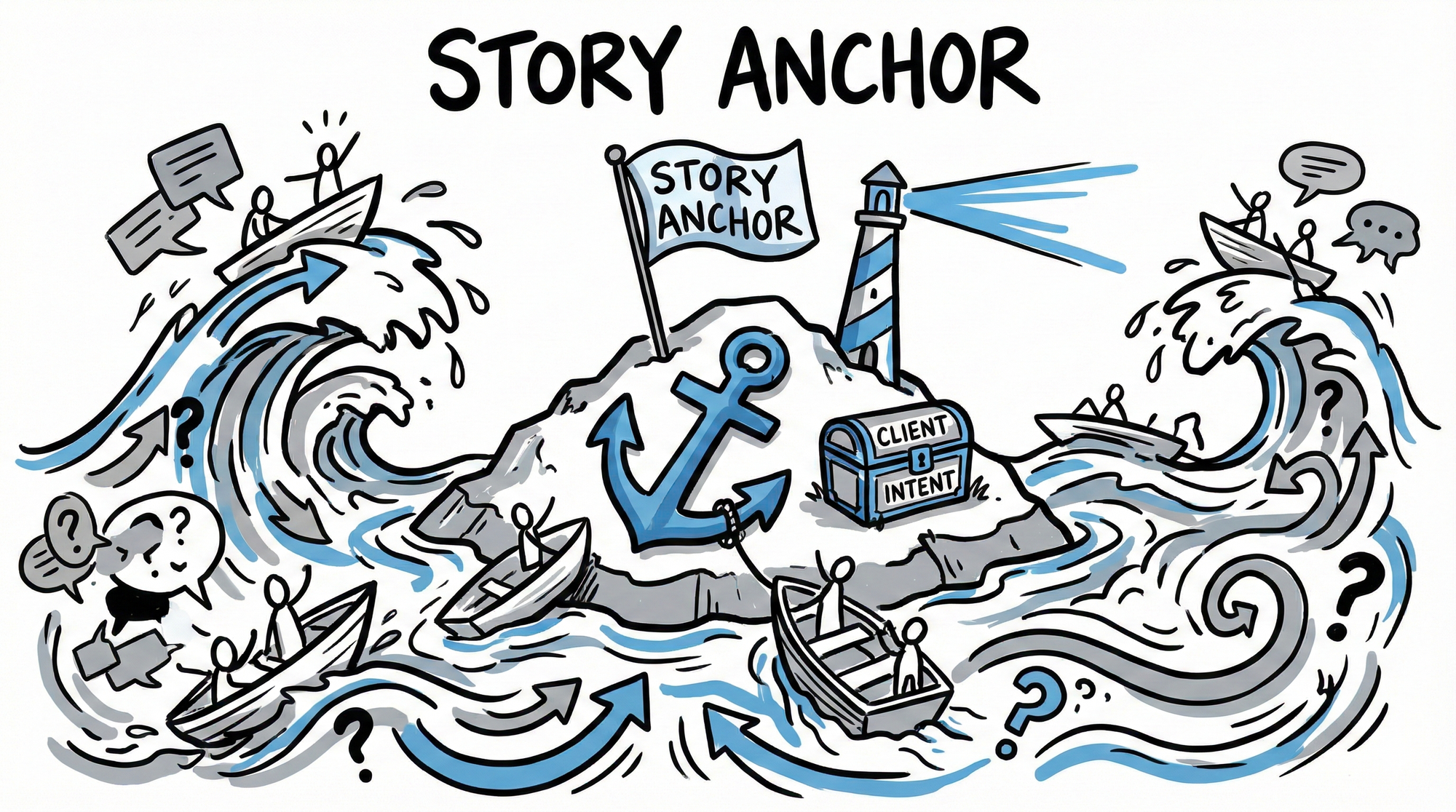
Every team gets the same document. When the PPC team asks about target CPA, they can see why that number matters to the client's actual business goal.
The Story Anchor is how client intent survives the handoffs.
It's the voice in the room that says: "We're still on the runway."
The Test
Here's how you know if your Story Anchor is working:
Give it to someone on the execution team who wasn't in discovery. Ask them:
- "What problem is the client trying to solve?"
- "How will we know if we've succeeded?"
- "What should you NOT work on?"
If they can answer all three correctly, your Story Anchor is working.
If they can't, your client's voice isn't reaching the people doing the work.
You have a Tenerife in your system.
Gates: Verify Before Proceeding
After Tenerife, aviation created explicit checkpoints for communication. Standard phraseology. Readback requirements. Mandatory acknowledgments before proceeding.
Gates.
A gate is a point where information fidelity is verified before work proceeds.
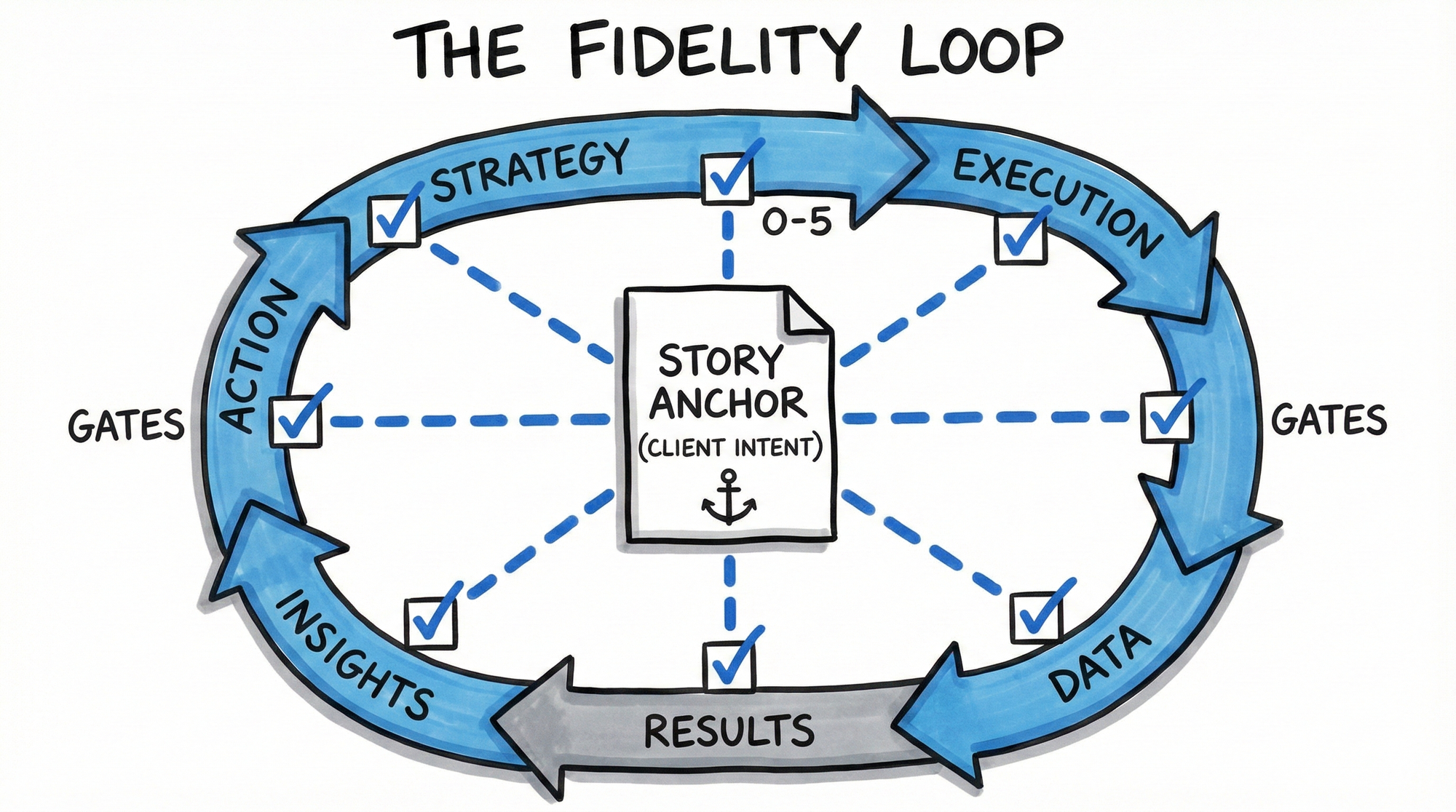
In account management, information flows through a cycle:
Strategy → Execution → Data → Results → Insights → Action → Strategy...
Every arrow is a handoff. Every handoff can lose fidelity.
We use six gates to check the handoffs:
| Gate | Handoff | Fidelity Question | Owner |
|---|---|---|---|
| Gate 0 | Client → Strategy | "Did client intent survive the translation?" | AM |
| Gate 1 | Strategy → Execution | "Can teams execute without clarification?" | AM |
| Gate 2 | Execution → Data | "Is measurement capturing what matters?" | Team Lead |
| Gate 3 | Data → Insights | "Do insights reflect actual performance?" | Team Lead |
| Gate 4 | Insights → Action | "Will recommendations drive the right behavior?" | Team Lead |
| Gate 5 | Action → Strategy | "Did learnings update the strategy?" | Team Lead |
Gates 0-1 carry most of the load.
If fidelity is high at the origin, downstream issues are smaller. If you only check two gates, check 0 and 1.
"I'll get that information later" is not passing the gate.
At Tenerife, "I'll confirm he's clear" would have taken three seconds. The captain didn't take them. He assumed.
Assumptions kill fidelity.
Gates Are Fractal
Here's what most people miss: the gates don't end after one cycle.
They repeat at every scale.
Every new project restarts the loop. Every strategic pivot triggers Gate 0 again. Every new stakeholder resets the fidelity chain.
| Scale | When the Cycle Restarts |
|---|---|
| Account | New client signed |
| Project | New scope received |
| Stakeholder | New contact introduced |
| Quarter | Strategy review |
The cycle operates at every scale simultaneously.
You never "finish" information flow.
You're always somewhere in the loop, at some scale.
Engine 2: Story Stream (Perception)
Beyond Preventing Surprises
There's another layer to information flow: what you communicate back.
The old view was defensive: tell clients about problems before they discover them. Prevent bad surprises.
That's necessary. But it's not enough.
The expanded view: narrate the client's hero journey back to them.
Think about what makes a great story: a hero faces an obstacle, struggles, and ultimately transforms. Your client is living that story. They hired you because something was blocking their path.
Story Anchor captures the first chapter. The quest. Where they are, what's blocking them, what they need.
Story Stream is the ongoing narration. The journey as it unfolds.
Not just "are we on track" but:
- Here's where you started
- Here's the obstacle we faced this month
- Here's how we overcame it
- Here's where you are now
Status updates report data. Story Stream tells the story.
Why This Builds Trust
Story Stream builds all four variables in the Trust Equation:
| Trust Variable | How Story Stream Builds It |
|---|---|
| Credibility | You understand their world well enough to narrate it |
| Reliability | You track progress against promises made |
| Intimacy | You see them. You tell their story back to them. They feel known. |
| Self-Orientation | The story centers them, not you |
The AM isn't just preventing fires.
The AM is the narrator of the client's hero journey.
That's why they stay.
Story Stream vs. Status Update
Consider the same information, two formats:
Status Update: "CTR increased 12% this month. CPA decreased to $45. We recommend increasing budget by 15%."
Story Stream: "When we started, you were paying $58 per lead and struggling to hit your quarterly target. This month, after restructuring the campaign around the audiences that actually convert, you're at $45. You're not just hitting target. You're building a system that compounds."
Both contain the same data. One checks a box. One builds trust.
The client who receives Story Stream doesn't just know what happened. They see their progress. They feel the momentum. They understand why this engagement matters.
That's the difference between a vendor relationship and a partnership.
Trust as the Highest Goal
Trust is why both engines exist.
- Story Anchor = promise of "we understand you"
- Gates = promise of "nothing falls through"
- Story Stream = promise of "we see your journey"
Promises made. Promises kept.
When something feels off in a client relationship, the Trust Equation becomes your diagnostic:
          Credibility + Reliability + Intimacy
Trust  =  ─────────────────────────────────────
                    Self-Orientation
- Credibility failing: They don't believe we know what we're doing
- Reliability failing: We haven't kept our promises
- Intimacy failing: They don't feel safe being honest with us
- Self-Orientation too high: They feel we care more about our success than theirs
Identify the failing variable. Trace it back to the upstream cause. Fix it there.
What I Missed for Years
Here's the realization that changed how I work:
I thought the Account Manager job was to be the connector. The person who bridges client and team. The translator. The one who holds it all together through sheer effort and responsiveness.
I was wrong.
That model doesn't scale. It burns you out. And it makes you the single point of failure.
The real job isn't being the connector. The real job is building the system that connects without you.
Story Anchor means the client's voice travels into rooms you're not in. Gates mean fidelity is verified without your presence. Story Stream means progress is visible without your constant narration.
When the system works, you're not running between handoffs catching dropped context. You're designing handoffs that don't drop context.
That's the shift: from being essential to building systems that don't require you to be essential.
The best AMs aren't the ones who are always available. They're the ones whose accounts run smoothly when they're not.
The Asymmetry (Upstream Principle)
Here's what makes information flow so critical:
Failures upstream cause failures downstream.
When Sales doesn't tell you why the client really hired you, your discovery goes in circles. When your discovery doesn't capture the real success criteria, execution teams optimize for the wrong metrics. When teams deliver something the client didn't ask for, you spend hours in damage control.
Fix upstream. Downstream improves.
But here's the trap: fixing upstream is invisible.
Nobody celebrates the meeting you didn't have to schedule because the handoff was complete. Nobody notices the fire drill that never happened because you asked the right question in discovery.
Prevention is invisible. Firefighting is heroic.
This creates a dangerous incentive: you appear valuable when putting out fires. But the best AMs prevent fires by nailing the information flow from day one.
The Irreducible Core
If you do nothing else:
- Story Anchor. Capture the client's quest.
- Gate 1. Confirm the team understands it before they start.
- Story Stream. Narrate the journey back to the client.
Everything else supports this or extends it.
Get these three right and most downstream problems don't happen. Skip them and you'll spend your career firefighting problems that started at the beginning.
The Standard
583 people died at Tenerife because three seconds of radio silence replaced three words: "He's not clear."
Your stakes are lower. But the mechanism is identical.
Information exists somewhere. Someone needs it. The handoff either works or it doesn't.
The shift is clear:
| Before | After |
|---|---|
| Reactive firefighting | Proactive systems |
| Being the connector | Building the connection |
| Essential and exhausted | Effective and scalable |
| Problems discovered late | Problems prevented early |
Build the anchor. Verify the gate. Narrate the journey.
That's information flow.
Go Deeper
Each element of Information Flow has its own mechanics:
- The Gate System — Structured checkpoints that prevent fidelity loss
- Story Anchor — How to carry client intent through every handoff
- Story Stream — Why narrating the journey builds trust that lasts
- Trust Unlocks Disclosure — Why clients withhold and how to create safety
- The Upstream Principle — Fix early, prevent late
See all Information Flow posts →
"The information existed. It just didn't flow. Three seconds of electronic noise where there should have been human voices."