Why Faster Beats Better
Speed of learning beats quality of planning. The organization with the fastest loop wins.
In 1950, the U.S. Air Force had a problem.
American pilots were flying the F-86 Sabre. Soviet pilots were flying the MiG-15. On paper, the MiG was superior in almost every specification.
Faster top speed. Better climb rate. Higher service ceiling. Heavier armament.
The F-86 had one advantage: the pilot could see better and react faster.
The kill ratio was 10:1 in favor of the F-86.
The plane with the faster loop won. Not the better specs.
John Boyd, the fighter pilot who analyzed this phenomenon, developed what became known as the OODA loop:
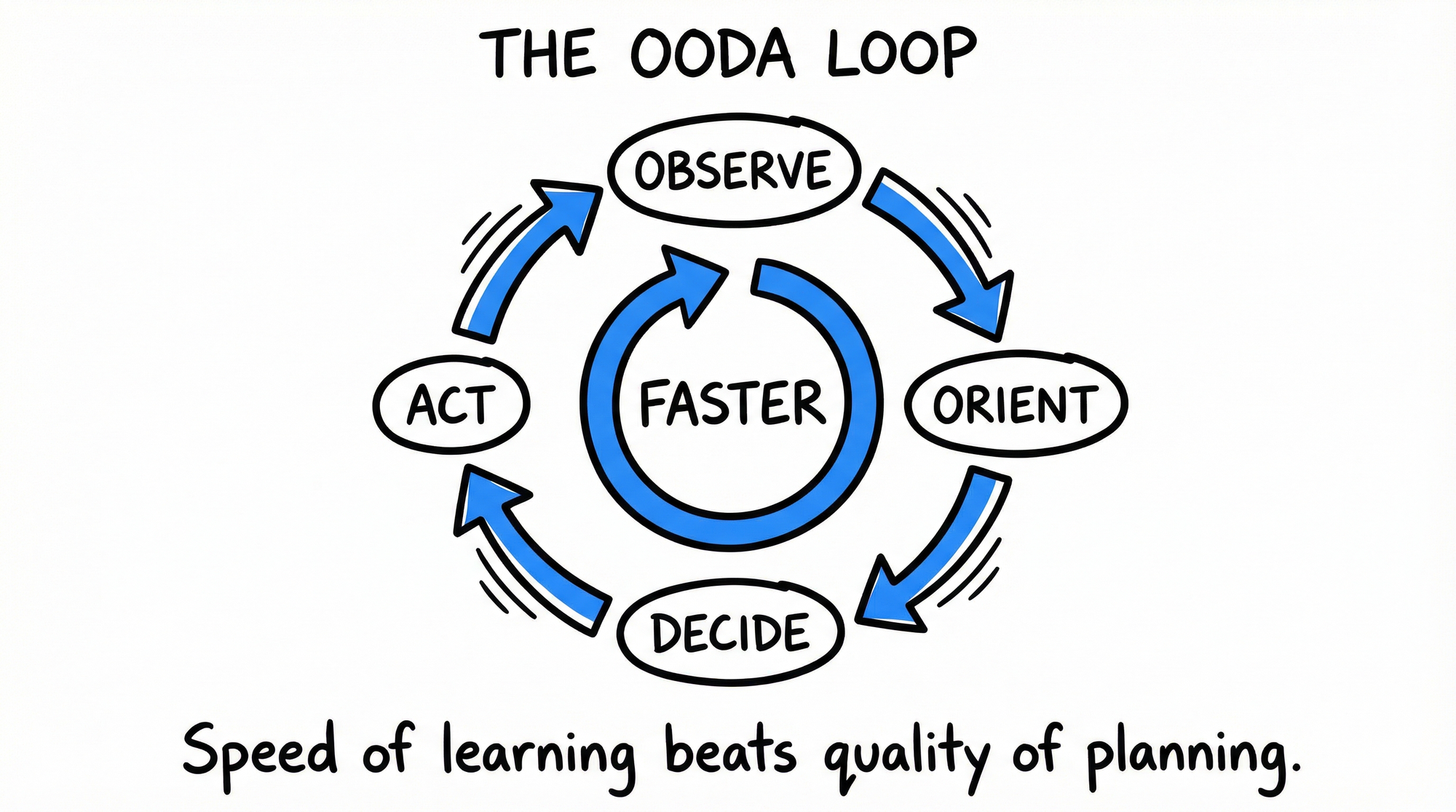
Observe → Orient → Decide → Act
Then loop back to Observe.
Boyd's insight wasn't that you needed a better plan. It was that the organization with the faster loop wins.
If you can cycle through observe-orient-decide-act faster than your environment changes, you adapt. If you can't, your plans become obsolete before execution completes.
Speed of learning beats quality of planning.
This shows up everywhere once you see it.
Toyota vs. GM at the NUMMI plant. Same workers. Same factory. Different loop speed.
GM's culture: plan extensively, execute carefully, review quarterly. Problems discovered months later. Context gone. Fixes expensive.
Toyota's culture: plan minimally, execute quickly, review constantly. Problems discovered immediately. Context fresh. Fixes cheap.
The same workers produced defect rates 10x better under Toyota's system. Not because they got smarter. Because the feedback loop collapsed from months to minutes.
SpaceX vs. NASA offers the same pattern.
NASA's approach: plan for years, build once, test extensively, launch when perfect. A single failure can end a program.
SpaceX's approach: build quickly, test constantly, explode frequently, learn fast. Failure is data.
Starship exploded on its first four test flights. Each explosion taught them something. By the fifth flight, it worked.
NASA's Space Launch System took 17 years and $23 billion to reach its first launch. SpaceX's Falcon 9 took 7 years and $300 million.
The faster loop won. Not the better plan.
Chris Argyris distinguished between two types of learning.
Single-loop learning fixes errors within the existing system. The thermostat adjusts the temperature.
Double-loop learning questions the system itself. Why is this the target temperature? Should we have a thermostat at all?
Single-loop learning keeps the gap between espoused and actual intact. It fixes symptoms without surfacing the underlying theory-in-use.
Double-loop learning surfaces the gap. It asks: Why do we have targets that can only be met through fraud? What does that reveal about our actual strategy?
Wells Fargo did single-loop learning for years. Employees got fired. Branches got audited. Compliance got tightened.
But the underlying system (impossible targets + consequences for missing them) stayed intact.
Double-loop learning would have questioned the system itself. That would have required a faster loop to the actual problem.
Amazon institutionalized fast loops through what Jeff Bezos calls "Day 1" culture.
Day 1 is a startup. Fast decisions. Customer obsession. Willingness to fail.
Day 2 is stasis. Slow decisions. Process obsession. Fear of failure. Then irrelevance. Then death.
Bezos's mechanism for staying Day 1: high-velocity decision making.
Most decisions are reversible (Type 2). They should be made fast by small teams with good judgment. If you're wrong, reverse it.
Only a few decisions are irreversible (Type 1). Those deserve slow, careful analysis.
Most organizations treat all decisions like Type 1. Everything requires extensive planning, multiple approvals, perfect information.
The loop slows to a crawl. By the time you decide, the environment has changed.
The organization with the faster loop wins.
The diagnostic is simple.
How long does it take to go from:
- Observing a problem to fixing it?
- Having an idea to testing it?
- Getting data to making a decision?
- Making a mistake to learning from it?
If the answer is "weeks" or "months," your loop is too slow.
Your competitors who answer in "hours" or "days" will outlearn you.
The fix isn't working faster. It's shortening the loop.
Shorten the observe phase: Make problems visible immediately. Real-time dashboards. Andon cords. Customer feedback loops that close in hours, not quarters.
Shorten the orient phase: Give decision-makers context. Cross-functional teams. Fewer handoffs. Information that doesn't degrade through translation.
Shorten the decide phase: Push decisions down. Empower small teams. Distinguish Type 1 from Type 2 decisions. Default to action on reversible choices.
Shorten the act phase: Deploy continuously. Test in production. Fail fast and small rather than slow and big.
Then loop back to Observe. Faster.
The goal isn't to eliminate the gap between espoused theory and theory-in-use.
The goal is to close it through faster learning.
Align espoused and actual. Then decide if that's who you want to be.
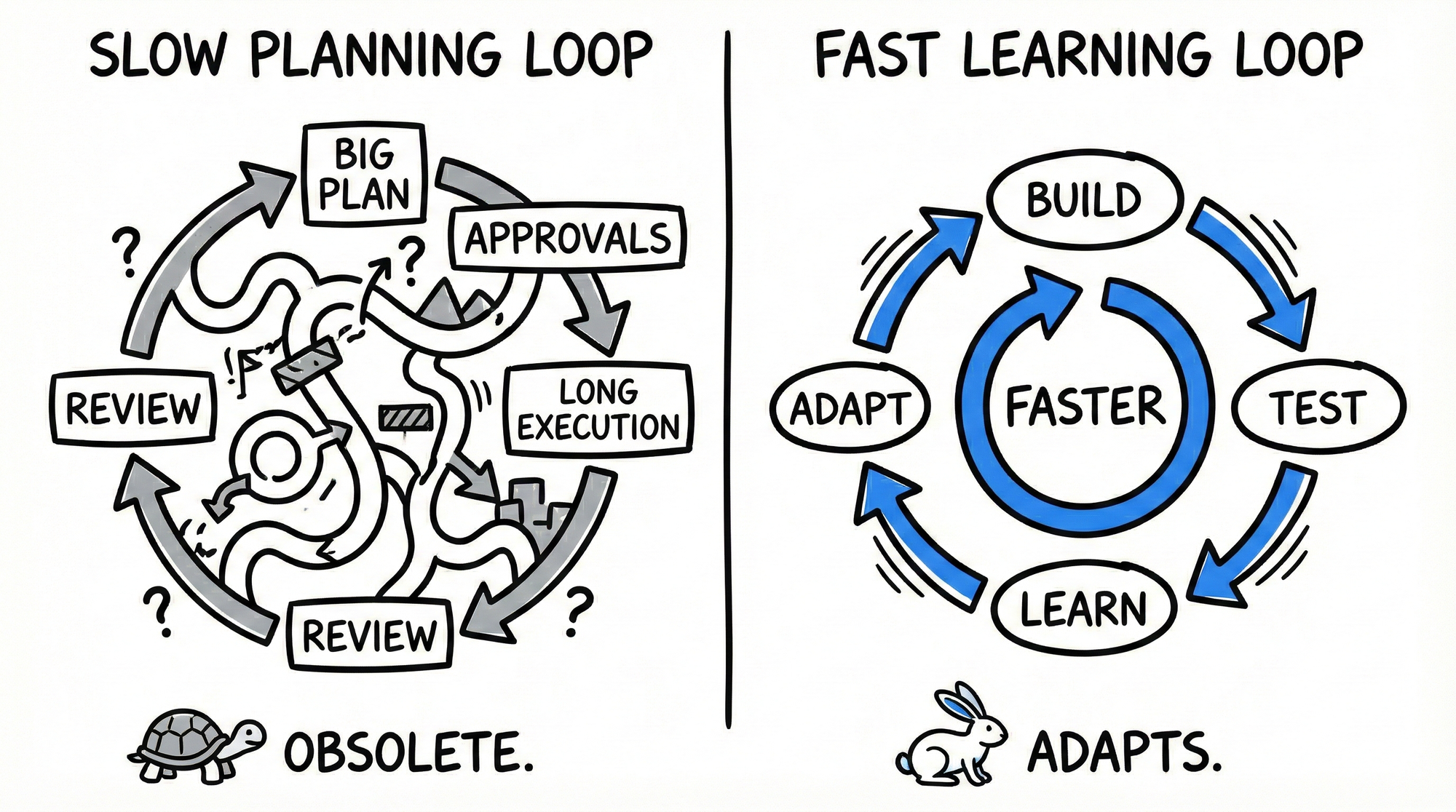
The faster the loop, the smaller the gap.
This post explores THE LOOP, one of four forces from Execution Reveals. Faster learning beats better plans. The organization with the fastest loop wins.