
We are Market-Side Builders.
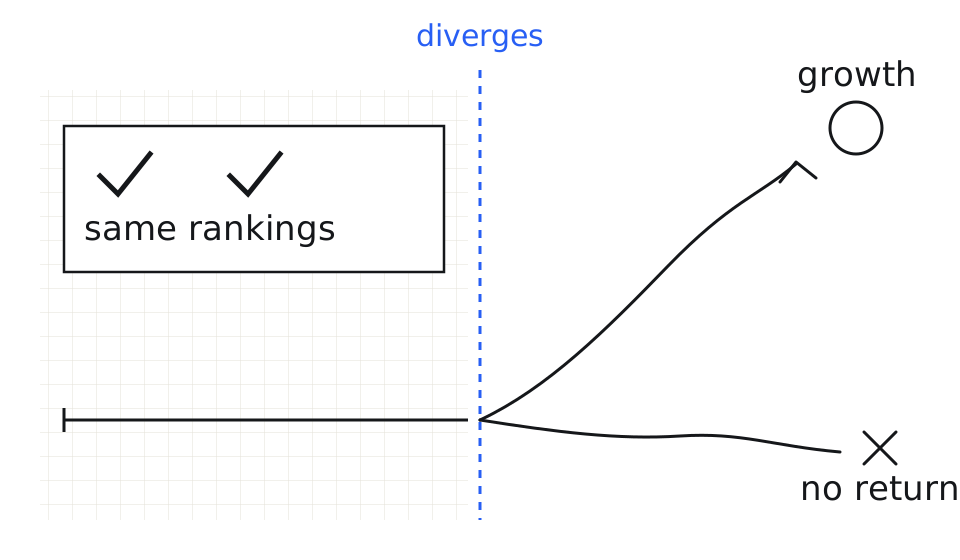
I once ran the same SEO for two clients and got the same rankings for both. One of them grew. The other never saw a return it could trace, and by the end they didn't believe the SEO had done anything.
It took me a while to see why, and the answer had nothing to do with the SEO.
I kept doing the right work and getting different results
Early in my career, most of my work was SEO.
I'd run the same best practices for two different clients and land the same rankings for both, then watch the results split completely. One client's rankings turned into real revenue, real growth they could point to and be genuinely happy about.
I ran the identical campaign for another client. Same rankings. Same technical work. They never saw a return they could trace back to it, and by the end, they didn't believe the SEO had done anything for them.
For a while, the obvious response was to look harder at the SEO itself. Better content. Better links. Better technical work.
But the rankings were already there. Both clients had them. Whatever was diverging wasn't the SEO.
The client seeing revenue was already doing everything else: offline outreach, email, brand advertising, their own reputation work. My SEO was amplifying momentum that already existed.
The other client had two problems SEO was never going to touch. Upstream, we were ranking for the wrong audience: real search volume, but not the buyer who was actually going to become a customer. Downstream, they had bad reviews sitting between a good ranking and a real decision. Fixing the SEO wouldn't have moved either number.
Same technique. Same execution. Same rankings. Opposite results where it actually mattered: the money.
The first time I actually saw that, it didn't feel like an insight. It felt like the floor moving. I'd built a whole practice on the assumption that the channel was the mechanism, and it wasn't. It was a system problem, and as a channel specialist I had no control over any of the system: who we were even ranking for, what happened once they arrived, everything else touching the same customer. One piece of a much bigger puzzle, and I'd been reporting on the piece as if it were the whole picture.
That wasn't a one-time realization. It happened enough times, on enough accounts, that it stopped being a lesson and became scar tissue: the kind of pattern you stop needing to be convinced of because you've been cut by it more than once.
Then I started asking questions that weren't mine to ask
Once I saw the system, I couldn't unsee it.
I started asking clients things that went beyond what I actually needed for SEO. Were they doing press releases? Local events? Anything that would touch the same reputation my rankings depended on.
Then I went further. Once a lead landed in the CRM, I started asking what happened to it. Did anyone call. How fast. Did it turn into a customer.
None of that was an SEO task. The outcome I actually cared about, a lead becoming money, sat entirely outside my job description.
At first it felt like overstepping. That's not my job.
But if I was actually going to care about the result, I couldn't pretend the boundary was real. The customer's experience doesn't know where my role ends.
That's what marketing became, for me: the set of activities that touch the market. If you're doing marketing, you have to get inside of it, not just your piece of it.
Marketing got bigger
Advertising is marketing. So is the website. So is pricing. So are reviews. So is how long a salesperson takes to return a call, and what happens on that call.
None of those live in a single department. All of them shape the same outcome.
The frameworks I'd learned were still useful. They were maps. I'd just stopped confusing them with the territory they were supposed to describe.
So I gave it a name
Some weeks the problem I'm chasing is the ads. Other weeks it's the data, a CRM workflow, a pricing page, or how quickly someone answers the phone.
Some people stay inside their discipline and work wherever they're pointed. Others follow the problem where it goes, through the channel, the system, and whatever sits on the other side of it. I call the second group Market-Side Builders. It isn't a company or a certification. Anyone who works this way is one of us.
I use the channel as a tool, never the goal. The outcome is the responsibility that doesn't move.
I chose the word Builder on purpose, not architect, not operator, not strategist, because those describe watching or deciding from a distance. Builder means action: making something that wasn't there, watching what happens when it meets the market, and building again.
Naming it took two years, and it took stepping outside my own head to get there. A marketer can't see his own tunnel vision any more than a fish can see the water it's swimming in. You need something outside the tank. For me that was Seth Godin's The Practice, and its actual advice: ship something, in public, on a schedule, whether it feels ready or not. So I started writing it out in small pieces and publishing them. Most of what I published in that stretch never found a permanent home; the discipline of shipping was the point, not any single post.
A few things change when you work from the market side
The dashboard says the campaign worked. Sales says the leads were junk.
- The map is not the territory. Frameworks help you see. They don't get the final vote. Reality does.
- Contact changes the plan. Every plan carries assumptions you can't see until you build against them.
- Data gets you closer, not there. Measurement narrows the gap to reality. It rarely closes it. Tracking has holes, and a dashboard is still a map.
- The system outranks the channel. A channel can perform perfectly while the system around it fails.
- The outcome doesn't respect the boundary. "That's not my department" doesn't change what the customer actually experiences.
When a recommendation fails, my name is still on it. A fair exchange means owning the downside of what I told you to do, not just the credit when it works. Years on the job don't automatically produce judgment, either. Untested experience is easy to overtrust, including my own.
Underneath all of it, we're designing for a change in someone's mind
Your buyers are each somewhere, carrying a problem they're trying to get through. The work is understanding where they are well enough to be useful: what they believe now, what they need to understand next, what's actually stopping them.
Advertising can do that. So can a website, a salesperson, a product experience, or a single conversation.
Now the maps are almost free
Ask a model for a plan this afternoon and you'll have one before your next meeting, along with the brief, the persona, the campaign structure, and the competitive analysis. That's genuinely useful. Capability got cheap.
What didn't get cheap is knowing which output to trust.
That makes the gap between the map and the territory matter more. When everyone has access to the same map, the advantage moves toward whoever is still willing to enter the territory: making contact, noticing what changed, rebuilding the plan around it. Chess found this out first.
Garry Kasparov lost to a supercomputer in 1997, and plenty of people decided human judgment in chess was done. Eight years later, the format changed: freestyle chess let anyone pair with any computer they wanted and compete as a team. The winners weren't grandmasters running the best hardware. They were two amateurs with a better process for working with their machines. Kasparov wrote afterward that a weak human with a machine and a better process beat a strong computer on its own, and beat a strong human with a machine and a worse process.
People like us work differently
We didn't get certified in this. We built a stance toward the work: care about the outcome more than the department, treat frameworks as maps, and expect the plan to change on contact with reality.
If that's familiar, the fuller version of what we stand for, and against, is written down.
Choose a trail
You've already been inside two or three of these. Here's the shape of the whole territory, named as five questions this site keeps returning to.
The Market. How do we get closer to reality? Customer understanding, demand, salience, the gap between the map and the ground.
Start with the Perception Engine →
The System. What is actually constraining the outcome? Handoffs, sales, operations, the information that gets lost between them.
Start with Proof of Transfer →
The Mind. How do people move from one belief to another? Decision-making, narrative, the customer's own journey.
Start with Confidently Wrong →
The Machine. What changes when intelligence becomes infrastructure? AI, agents, data, automation.
Start with Order Beats Presence →
The Craft. How do we turn thinking into things that survive contact with reality? Building, testing, learning, doing it again.
Start with Completion Isn't Contribution →
I write from the territory
Ideas I'm still working through. Patterns I'm noticing. Questions that won't leave me alone.
I send the ones worth sharing by email. If that sounds useful, you're welcome to join.
Or keep exploring. Everything here stays open either way.
A little about me
I've spent more than twenty years in marketing, in-house, agency, and consulting, and picked up code, data, and analytics along the way because the problems required it.
This site is where those interests meet: how a business actually touches its market, and what it takes to get close enough to that reality to build something that survives it.
The map helps. The market decides. I build accordingly.