
The Series B Death Spiral
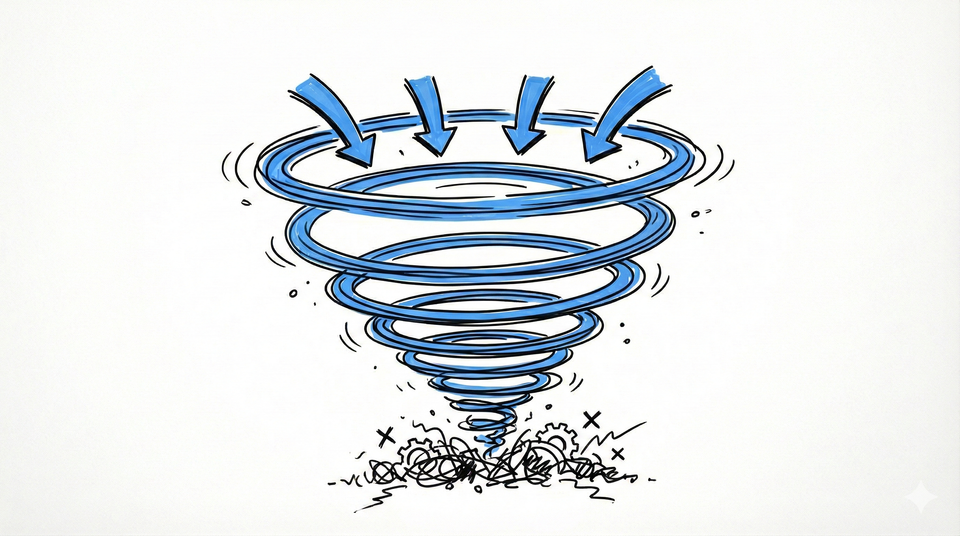
You're about to make four mistakes simultaneously. And they don't add. They multiply.
Your startup just raised Series B.
You're about to make four mistakes simultaneously.
Not because you're bad at your job. Because you're about to violate four organizational physics laws at once. And when they interact, they don't add. They multiply.
The pattern is predictable.
Series B means growth. Growth means hiring. Hiring means your company will cross from 50 to 150 people in about 18 months.
At 50 people, you have 1,225 possible relationships to manage. At 150, you have 11,175. That's not a 3x increase in headcount. It's a 9x increase in coordination overhead.
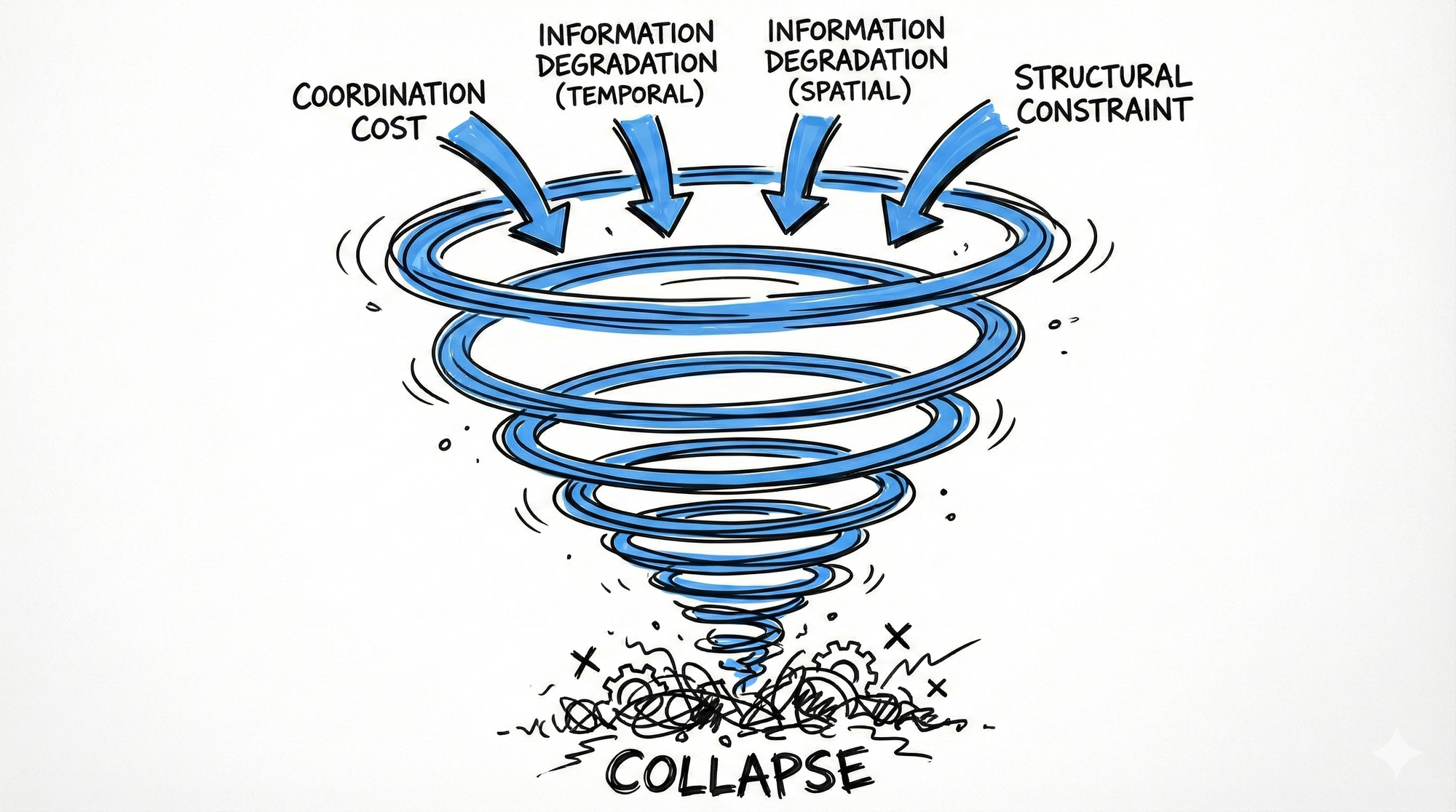
First law violated: Coordination Cost Scaling.
To manage that coordination, you add meetings.
The number of meetings has tripled since 2020. In growth-stage companies, 68% of employees don't have enough time for focused work.
But it's worse than lost time.
One meeting that goes badly spills into the next. Participants carry tension across conversations. Issues raised in the morning cascade through the afternoon. By end of day, three unrelated decisions are delayed because the same twelve people are in all twelve meetings.
Nobody designed this. It emerged from the collision between growth and coordination needs.
Second law violated: Temporal Information Degradation. Feedback loops stretch. Context decays between conversations. By the time you identify a problem, the original context is gone.
Meanwhile, you're hiring specialists.
At 30 people, everyone knows everything. At 100, knowledge fragments into silos.
Research shows two-thirds of senior managers believe their organization explains major decisions well. Only one-third of frontline employees agree.
The message that leaves leadership arrives at the edges transformed beyond recognition. Not because anyone distorts it intentionally. Because every handoff compresses context. Five handoffs, five compressions. What remains is summary of summary of summary.
Third law violated: Spatial Information Degradation. The organization grows faster than information can flow through it. Teams execute something different than what was intended.
And the architecture that got you here can't get you there.
Your codebase was built for speed. Ship fast, fix later. That made sense at three engineers racing to product-market fit.
Now you're forty engineers. Every shortcut from the early days has compound interest.
Engineers at growth-stage startups spend 42% of their time fixing bad code and workarounds. Almost half their capacity goes to paying interest on yesterday's debt instead of building tomorrow's features.
Features that took two weeks now take six. The team isn't slower. The architecture is fighting them.
Fourth law violated: Structural Constraint. The monolith that enabled early speed becomes the prison that prevents late speed.
Here's where it gets dangerous.
These four dynamics don't operate in isolation. They reinforce each other.
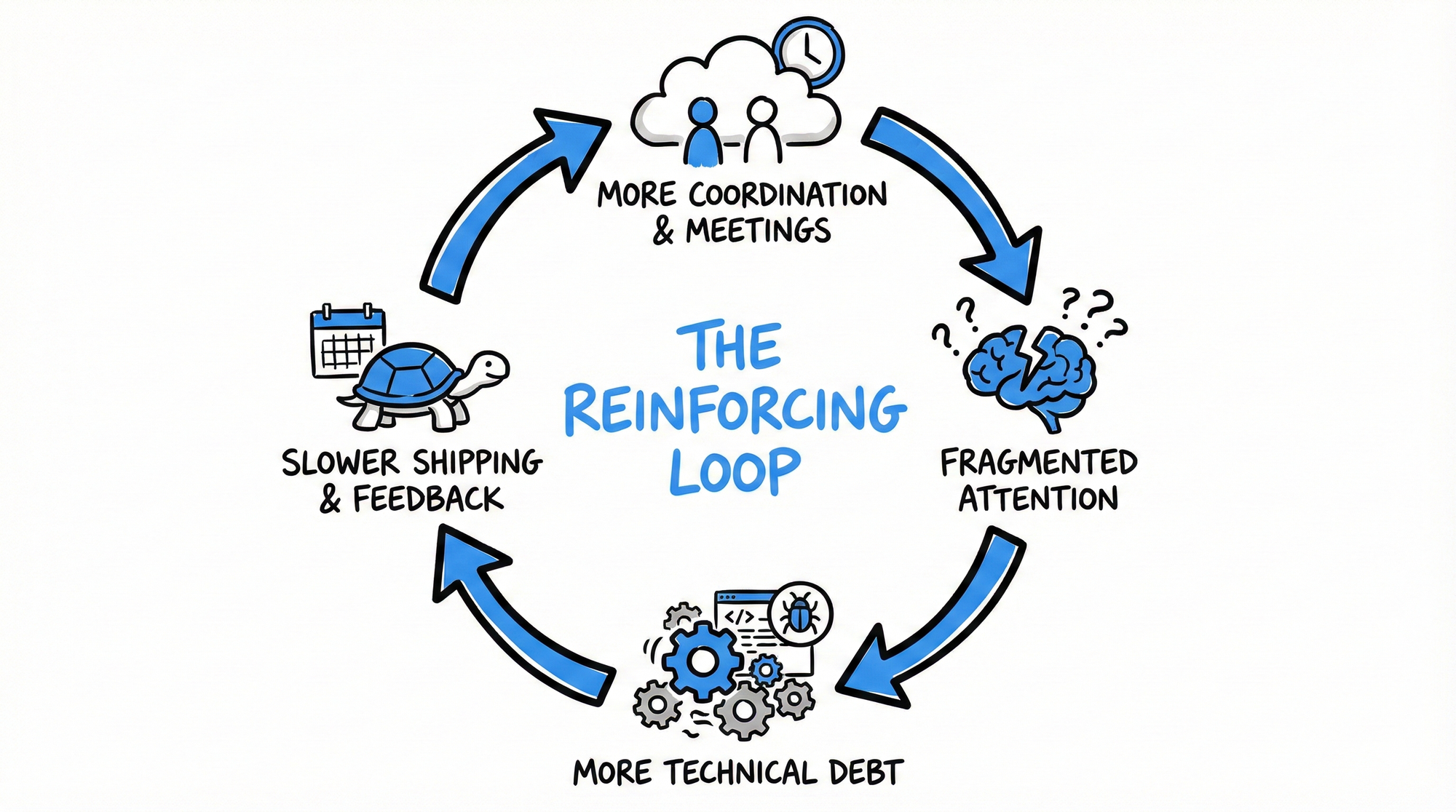
Technical debt slows shipping. Slower shipping means longer feedback loops. Longer feedback loops mean problems are discovered late, when context is gone. Decisions without context create more technical debt.
Coordination overhead increases meetings. More meetings fragment attention. Fragmented attention means less time to address technical debt. Unaddressed debt requires more coordination to work around.
Information degrades across handoffs. Degraded information leads to misaligned implementations. Misaligned implementations require architectural patches. Patches increase complexity. Complexity requires more handoffs.
The Startup Genome report found that 70% of tech startup failures come from premature scaling. Not bad products. Not lack of funding. Organizational physics violations that compound into collapse.
Knight Capital learned this in 45 minutes.
On August 1, 2012, they deployed code with a dormant bug. The bug had been there for years, accumulating like technical debt. When new code accidentally reactivated it, their trading system went haywire.
In 45 minutes, the software bought $7 billion in unauthorized stocks. Loss: $440 million.
Knight Capital, an 18-year-old trading firm, sold within days.
The debt wasn't obvious until it compounded. The system looked fine until it wasn't.
The diagnostic is a set of questions.
Coordination: When someone says "let's align," how many people? If the answer exceeds 7, you've crossed a threshold.
Temporal: How long between identifying a problem and fixing it? If weeks, feedback loops have stretched too far.
Spatial: Can a frontline employee explain your strategy accurately? If leadership's message arrives transformed, your organization is too tall for information to flow intact.
Structural: What percentage of engineering time goes to maintenance? If approaching 40%, the architecture is consuming itself.
Each symptom alone is concerning. Watch for the interaction: when coordination problems create temporal problems that create spatial problems that create structural problems. That's the spiral.
The intervention points are specific.
For coordination: Break into smaller units before you're forced to. Amazon's two-pizza teams aren't about pizza. They're about keeping n small so n-squared stays manageable.
For temporal: Collapse feedback loops deliberately. Elite performers deploy hundreds of times daily. Faster feedback means fresher context.
For spatial: Minimize boundaries. Product teams that own end-to-end have fewer handoffs. Fewer handoffs mean less translation.
For structural: Pay down debt continuously. Teams that allocate 15-25% of capacity to technical debt work keep interest from compounding. Teams that don't eventually spend 42% just servicing it.
Series B success often triggers Series C failure.
The behaviors that got you funded are the behaviors that will kill you if you don't change them.
Move fast and break things works at five people. At fifty, the broken things pile up. At 150, the pile collapses.
The physics doesn't care about your ambition. The physics doesn't care about your culture.
Coordinate n people? Costs n-squared. Stretch a feedback loop? Lose context. Add a handoff? Degrade information. Defer a fix? Pay compound interest.
These aren't suggestions. They're laws. Violate them simultaneously and they don't add. They multiply.
The Series B Death Spiral isn't mysterious. It's predictable. The question is whether you design around it before it designs around you.
This post explores Interaction Effects, showing how the four dynamics from The Momentum Engine compound when violated simultaneously. Each mistake makes the others worse. That's not a bug. That's the physics.